

SaaS Development Company: How to Choose the Right Partner
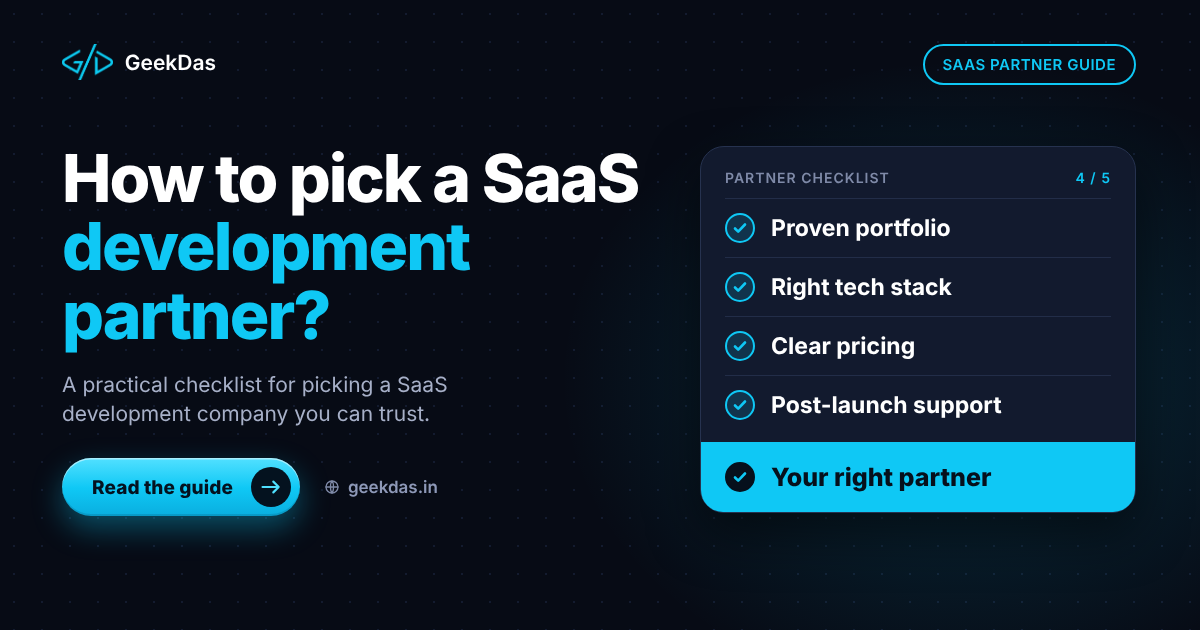
Choosing who builds your SaaS product is one of the few decisions in a startup that is genuinely hard to undo. A wrong choice rarely fails loudly. It fails slowly: a first version that technically works but cannot take payments cleanly, a codebase nobody else can read, and a budget that is gone before real users arrive.
This guide is for founders and business owners who have decided to build a subscription product and now need to pick a partner. It explains what a SaaS development company (or developer) should actually deliver, the realistic options, how to compare them, and the questions that separate a reliable partner from a risky one. If you are still deciding what to build, start with the step-by-step SaaS roadmap first and come back here.
What a SaaS development partner actually delivers
A SaaS product is more than its headline feature. Before anyone pays you, a long list of unglamorous things has to work. A capable partner builds all of them, not just the screens.
The parts that are easy to forget
Sign-up, login, password reset and email verification
Teams or workspaces, invites and role-based access
Plans, trials and recurring subscription billing with failed-payment handling
Usage limits and feature gating by plan
An admin back office for support, user management and revenue visibility
Transactional email and in-app notifications
Hosting, backups, monitoring and a repeatable deployment process
When a quote lists only the "main features", ask where these are. Together they are a large share of the real work, and they are where underquoted projects run into trouble. A good starting point is a partner that offers end-to-end SaaS development as a defined scope rather than a list of pages.
Your options, compared
There is no universally best provider type. The right one depends on your budget, how well defined the product is, and how much you want to manage.
Option | Best for | Strengths | Trade-offs |
|---|---|---|---|
Solo full stack developer | A focused first version, tight budgets, founders who want direct access | One person owns design-to-deploy; fast decisions; low overhead; you talk to the person writing the code | Single point of capacity: availability, holidays and illness matter. No in-house designer or QA unless arranged |
Freelance marketplace hire | Small, well-specified tasks | Wide choice, quick start | Quality varies a lot; vetting is on you; continuity risk |
Boutique agency | Products needing design, development and project management together | Multiple skills, process, some redundancy | Higher cost; account managers sit between you and developers |
Large agency | Complex products with many stakeholders and compliance needs | Scale, formal processes | Highest cost; junior staff often do the build; slower changes |
In-house team | Long-term core product | Full control and context | Recruitment time and salary cost; heavy before product-market fit |
For many early-stage products, a solo full stack developer or small boutique team gives the best ratio of speed to cost. As the product and team grow, you can bring development in-house with the code and documentation you already own. For the specific case of full stack hiring models, see the full stack developer hiring guide.
How to evaluate a SaaS development company
1. Look for SaaS-specific experience, not just "web development"
Ask which subscription products they have built and what was hard about them. Good answers mention concrete problems: how tenants are isolated, how billing webhooks are made reliable, how plan limits are enforced. Vague answers about "scalable solutions" are a warning sign.
GeekDas, for example, has built WhatsApp automation platforms with real-time messaging, visual flow builders and team inboxes, a link-in-bio and analytics product, and a WhatsApp marketing tool with AI features. That is the kind of specific, verifiable context to ask any provider for.
2. Check how they handle multi-tenancy
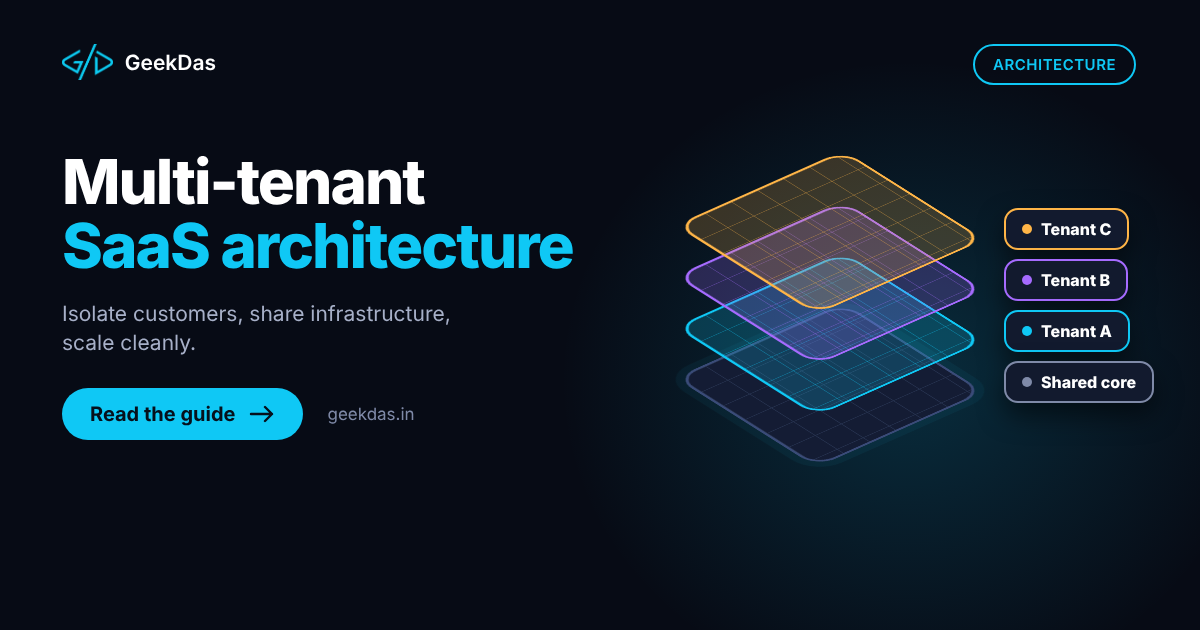
Many customers share one product, and their data must never mix. Ask how the provider isolates tenants: a shared schema with a tenant column, separate schemas, or separate databases. There is no single right answer, but there must be a clear one. The trade-offs are covered in multi-tenant SaaS architecture explained.
3. Ask about billing early
Billing is where SaaS projects most often slip. A reliable partner will talk about webhook handling, retries, idempotency, proration, trials, failed payments and invoices before you mention them. If billing is "added at the end", expect delays.
4. Review their approach to the first version
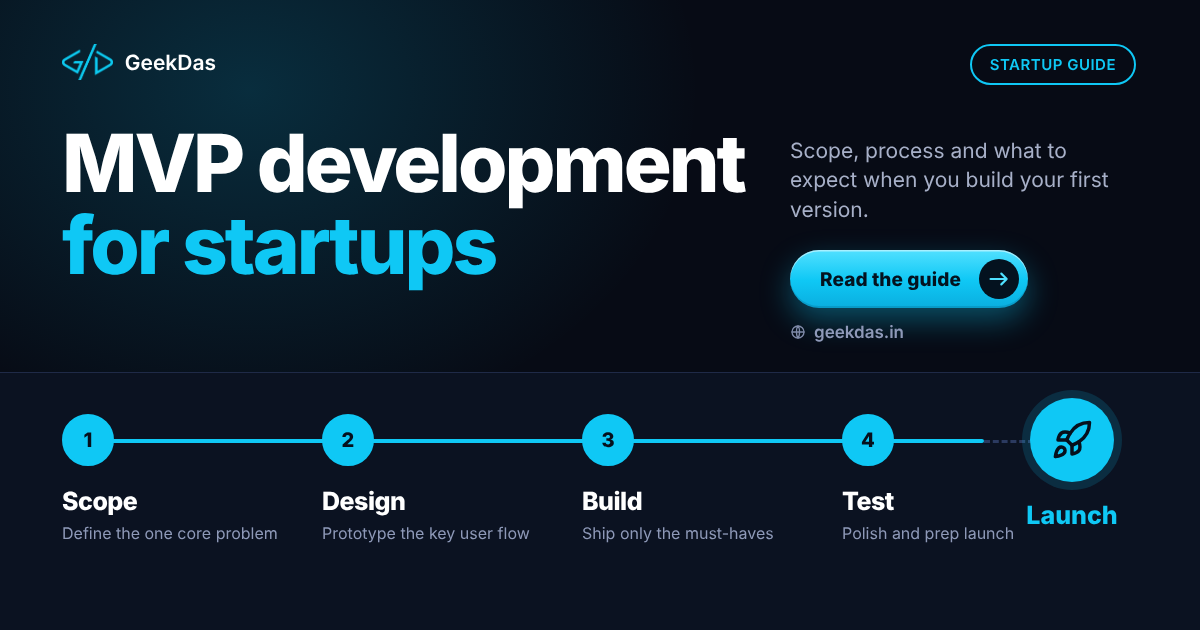
A partner who agrees to build everything you list is not helping you. Look for one who pushes back, helps you define the smallest version that tests your assumption, and structures the code so later features do not mean a rewrite. The thinking behind this is laid out in MVP development for startups.
5. Confirm ownership and handover
You should own the source code, the cloud accounts and the domain. Ask for this in writing, plus documentation good enough for another developer to continue. This single point protects you more than any other contract clause.
6. Understand the communication model
Ask how often you will see working software, who you speak to, and how decisions and changes are recorded. Short build cycles with working previews are far safer than a long wait for a big reveal.
Technology choices: what is reasonable
You should not need to pick the stack yourself, but you should be able to judge the reasoning. For most SaaS products:
Frontend: React or Next.js. Large ecosystems, easy to hire for later.
Backend: Node.js (Express or NestJS) or Laravel. Both are mature. The choice is covered in Node.js vs Laravel for your backend.
Database: PostgreSQL or MySQL. SaaS data is almost always relational.
Infrastructure: Docker, a managed database, automated backups and a CI/CD pipeline.
Be cautious about providers who push a niche or proprietary framework, or who propose microservices for a first version. A well-structured single application is faster to build, cheaper to run and easier to split later.
What drives SaaS development cost
Any honest quote depends on a handful of factors. Be wary of a figure given without asking about them.
Cost driver | Why it matters |
|---|---|
Number and complexity of core workflows | Each distinct workflow is real design and testing effort |
Billing model | Flat plans are simpler than usage-based or per-seat billing with proration |
Multi-tenancy model | Stricter isolation costs more up front and less later |
Third-party integrations | Each external API adds work for errors, retries and testing |
Real-time features | Live updates and messaging need extra infrastructure and care |
Design effort | Custom UX takes longer than a component-library look |
Compliance and security needs | Audit logs, data residency and certifications add scope |
Timelines on GeekDas service pages give a realistic anchor: a first SaaS version with accounts, billing and the core feature usually takes 6 to 12 weeks. That is a planning range, not a promise; your scope decides.
Red flags when choosing a partner
A fixed price quoted before any conversation about scope
No mention of billing, tenancy, security or backups
Reluctance to confirm that you own the code
Pressure to start immediately without a written scope
Portfolio screenshots with no live product to inspect
Guaranteed outcomes ("first page of Google", "ready to scale to millions")
No clear answer on who is available when something breaks after launch
Questions to ask before you sign
Which SaaS products have you shipped that I can see live?
What is the smallest version you would build for my idea, and what would you leave out?
How will you isolate each customer's data?
How will subscription billing and failed payments be handled?
Who owns the code, the repository and the cloud accounts?
What does the handover include (documentation, deployment steps, credentials)?
How do you handle changes in scope, and how are they priced?
What happens in the first month after launch?
Global and India-specific considerations
Working with a development partner in a different country is routine for SaaS. A few practical points make it smoother.
Time zones: Look for a regular overlap window and written updates. A developer in India (IST, UTC+5:30) typically overlaps with Europe in the morning and with US time zones in the evening.
Payments and invoicing: Agree the currency, payment schedule and who pays transfer fees up front. Indian providers can invoice internationally; confirm tax and invoicing arrangements with your accountant.
Contracts: Put IP assignment, confidentiality and a payment-milestone structure in writing, whatever the provider's location.
Data protection: If your users are in the EU, UK or other regulated regions, ask how personal data will be stored and which processors are involved.
The outsourcing process in more detail is in software development outsourcing to India.
Why consider GeekDas
GeekDas is a full stack developer practice based in Jaipur, Rajasthan, working with clients in different time zones. You deal with one person from the first call to launch, who builds the interface, the API, the database and the deployment. That suits products where speed, direct communication and a modest budget matter more than a large team. It is not the right fit for every project: if you need several specialists working in parallel, a formal compliance process or round-the-clock support, an agency may serve you better, and I will say so.
Conclusion
The right SaaS partner is the one who asks about billing, tenancy and scope before they quote, who is honest about what they would leave out of version one, and who hands you the code and the keys. Compare providers on those points rather than on portfolio polish or the lowest price.
If you want a second opinion on scope or a plan for a first version, get in touch with your idea and timeline. You can also read how the SaaS development service works in detail.
Was this article helpful?
Comments
Leave a comment
Loading comments...