

Software Development Outsourcing to India: A Guide for Global Clients
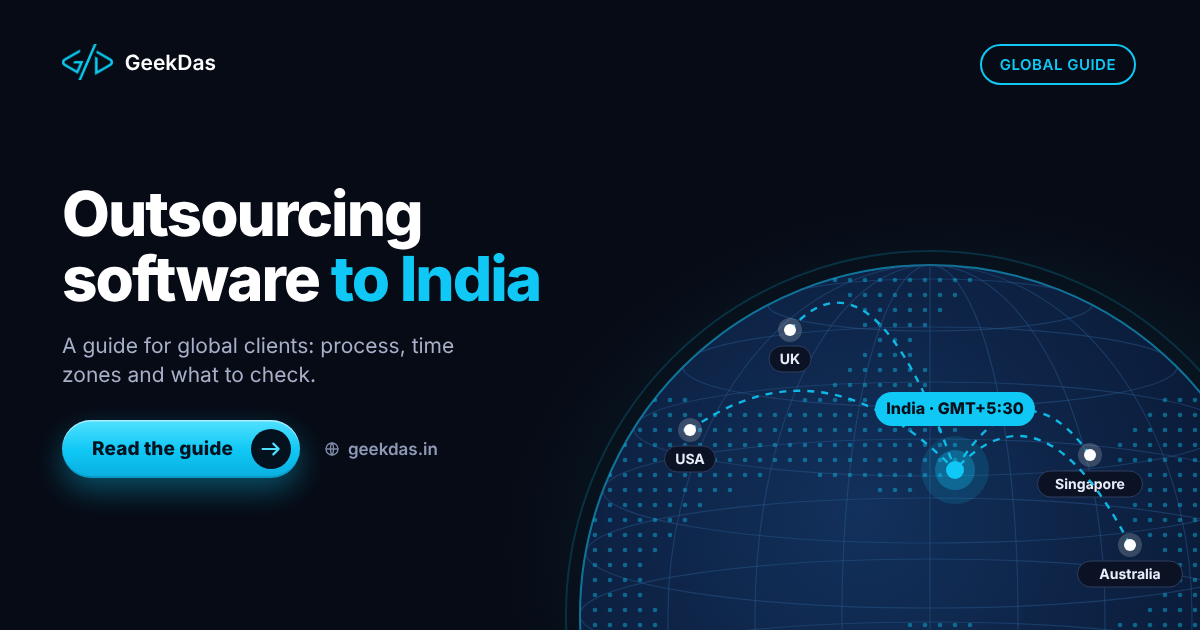
India is one of the largest sources of software talent in the world, and businesses in the US, UK, Europe, the Middle East and Australia routinely work with developers there. The upside is real: access to experienced engineers and cost efficiency. So are the risks: unclear scope, communication gaps and mismatched expectations. Outsourcing succeeds or fails on how the project is set up, not on the country.
This guide is for international clients, agencies and founders who are considering working with a software partner in India. It covers who you can hire, how projects are structured, contracts and IP, time zones, payment and tax basics, quality control and how to choose well. It is deliberately about the process of outsourcing a project. If you are specifically deciding whether to hire a full stack developer, the full stack developer hiring guide covers that decision.
Why companies outsource software development to India
Skill depth. A large pool of developers experienced in modern stacks (React, Next.js, Node.js, Laravel, mobile and AI).
Cost efficiency. Rates are generally lower than in the US, UK or Western Europe, though they vary widely with experience and provider type.
Flexible capacity. Scale from a single developer to a team, or pause between phases.
Time coverage. A working day offset from yours can extend coverage of your product.
English proficiency. Most professional developers work in English daily.
Cost is not the only reason, and it should not be the main one. Low price with poor communication is more expensive than a fair price with reliable delivery.
Who you can work with
Provider type | Best for | Strengths | Trade-offs |
|---|---|---|---|
Solo full stack developer | Focused products, MVPs, extending an existing app | Direct communication, speed, low overhead | One person's capacity and availability |
Freelance marketplace | Short tasks | Choice and speed of hiring | Vetting is on you; variable quality |
Boutique studio | Product design and build together | Multiple skills, some redundancy | Higher cost |
Large IT services company | Large programmes, compliance-heavy work | Scale and formal process | Cost, layers, slower change |
Dedicated team through a staffing partner | Long-term extension of your team | Continuity | Management effort on your side |
For related guidance on evaluating partners for subscription products, see how to choose a SaaS development partner.
Engagement models
Model | How it works | Suits | Risk to manage |
|---|---|---|---|
Fixed scope, fixed price | Agreed feature list and price | Well-defined projects | Scope changes need a clear process |
Time and materials | Pay for hours or days worked | Evolving products | Needs good reporting and budget caps |
Monthly retainer | A set amount of availability per month | Ongoing development and maintenance | Define what the hours cover |
Dedicated developer | Full-time capacity on your product | Long-term development | Manage like a team member |
For a first project with a new partner, a small fixed-scope paid engagement is a low-risk test before a larger commitment.
Setting up the project for success
1. Write a clear brief
State the problem, users, core workflows, integrations, success criteria and constraints. A one-page brief is better than none. Include what is out of scope.
2. Agree the first deliverable
Define a small, concrete first milestone. It shows how the partner works long before the stakes are high.
3. Insist on working software early
Ask for a working preview every one to two weeks rather than a single reveal at the end. This is the best protection against surprises.
4. Use your own accounts
Source code should live in a repository you own, with the developer invited to it. Cloud, domain and app store accounts should also be in your name. This turns ownership from a legal clause into a practical fact.
5. Document decisions
Keep scope changes, approvals and key decisions in writing, in a shared tracker or email thread.
Contracts, IP and confidentiality
Take professional legal advice for your jurisdiction. As a general checklist, an agreement usually covers:
Scope and deliverables with acceptance criteria
Payment terms tied to milestones
IP assignment: all work product belongs to you on payment
Confidentiality or NDA
Handling of third-party and open-source components
Warranty or bug-fix period after delivery
Change process for scope changes
Termination terms and handover of code and accounts
Make sure the developer is not reusing code that belongs to another client, and that licences for any third-party components are clear.
Time zones and communication
India Standard Time is UTC+5:30 and does not observe daylight saving, so the overlap with your region shifts over the year.
Your region | Typical overlap with India working hours |
|---|---|
UK and Western Europe | Several hours, mainly your morning and India's afternoon |
Middle East | Large overlap |
Australia and Singapore | Large overlap |
US East | Limited, mainly your morning and India's evening |
US West | Narrow; plan on asynchronous work plus one fixed call |
Agree a fixed overlap window, a response-time expectation, a weekly demo and written daily or weekly updates. Asynchronous work with clear tickets and screen recordings works well across large time differences.
Payments, invoicing and tax basics
Currency and method. Agree currency and payment channel in advance, and who bears transfer fees.
Invoicing. Indian providers can invoice international clients; the details, including GST treatment of exported services, depend on the provider's registration. Confirm with your accountant and the provider.
Withholding or local tax. Some countries require withholding on payments abroad; check your local rules.
Milestones. Tie payments to delivered, reviewed work rather than paying everything upfront.
Managing quality
Use a staging environment and test each release yourself.
Ask for automated tests on critical flows such as sign-up and payments.
Review the code periodically or have an independent developer do a short code review.
Track progress against milestones, not hours alone.
Ask for deployment steps and documentation so that you are never dependent on one person.
Common mistakes
Choosing on price alone. The lowest quote often omits testing, security or documentation.
Vague scope. Most disputes start here.
No ownership of accounts and repositories.
Large upfront payments with no deliverable.
No regular demos.
Assuming time zones will sort themselves out. Agree overlap explicitly.
Treating the partner as a vendor, not a collaborator. Share context about users and goals.
Red flags when evaluating a provider
Unrealistically fast or cheap estimates with no discussion of scope
Reluctance to confirm code ownership in writing
No live work you can inspect
Guaranteed results ("number one ranking", "zero bugs")
Pressure to sign immediately
No clear person responsible for your project
What to expect from a good partner
Questions about your users and goals before a quote
A written scope, timeline and price
Honest advice, including when not to build something
Regular working demos
Clear handover of code, accounts and documentation
A plan for support after launch
Outsourcing to a Jaipur-based developer
Geography within India matters little for the work, but it affects a few practicalities such as working hours, local holidays and availability for visits. GeekDas is based in Jaipur, Rajasthan, and works in IST with clients in different time zones. Businesses in Rajasthan can read the dedicated guide to web development companies in Jaipur.
Why GeekDas
GeekDas is a one-developer practice with more than five years of full stack experience, covering web applications and SaaS, websites, e-commerce, mobile apps and AI integration. You get a single point of contact, a written scope and price before work starts, working previews during the build and a handover of full source code. This works well for focused projects and early-stage products. For work that needs several specialists in parallel, I will say so openly.
Conclusion
Outsourcing to India can give you strong engineering at a sensible cost, provided the project is set up well: a clear brief, a small first milestone, working demos, ownership of your accounts and code, and agreed communication. Choose partners for honesty and reliability, not only price.
If you are planning a project and want a clear scope and timeline, send me a brief and we can start with a small first milestone.
Was this article helpful?


Comments
Leave a comment
Loading comments...