

MVP Development for Startups: Scope, Process and What to Expect
Most startups do not fail because their first version was too small. They fail because it took too long to find out whether anyone wanted it. A minimum viable product (MVP) exists to shorten that learning time: build the smallest thing that tests your most important assumption, put it in front of real users, and let their behaviour decide what comes next.
This guide covers what an MVP is and is not, how to decide what goes into it, how the build works from scoping to launch, what drives cost and timeline, and the mistakes that most often turn a six-week MVP into a six-month project. It is aimed at founders without a technical background as much as at product owners who have built software before.
What an MVP is (and what it is not)
An MVP is the version of your product with just enough functionality to deliver value to early users and to teach you something you could not have learned without building. The key word is "viable": it must actually solve the problem, not merely demonstrate it.
MVP vs prototype vs proof of concept
These terms are often mixed up, and choosing the wrong one wastes money.
Proof of concept | Prototype | MVP | |
|---|---|---|---|
Question it answers | Can this be built? | Does this design make sense? | Will people use and pay for this? |
Audience | Internal or technical | Test users, investors | Real customers |
Code quality | Throwaway | Often none (clickable mock-up) | Production-quality, built to extend |
Typical output | A technical experiment | Clickable screens | A live product |
If you want to know whether customers will pay, a prototype is not enough. If you only need to settle a technical risk, a proof of concept is cheaper than an MVP.
Why start with an MVP
Learn before you spend. Real usage reveals which features matter. Founders consistently find that some of their favourite ideas are ignored and an unplanned feature becomes the product.
Reduce risk. A smaller build limits what you can lose if the idea needs to change.
Show traction. A live product with real users is far stronger for investors and pilot customers than a slide deck.
Keep momentum. Short cycles keep the team and the feedback loop energised.
If your idea is already clear and you are planning a larger product with billing and teams, the broader path is described in the SaaS roadmap from idea to launch. This article focuses on the first, smaller version.
How to decide what goes into the MVP
Scoping is where MVPs are won or lost. A reliable method:
Step 1: Write down your core assumption
Complete this sentence: "I believe [this type of customer] will [do this action] because [this problem] is painful enough." Everything in the MVP exists to test that sentence.
Step 2: List every feature you can think of
Be generous. Include the accounts, dashboards, notifications and settings you assume you will need.
Step 3: Keep only what is needed to test the assumption
Ask of each feature: could a user complete the core action without it? If yes, it goes on a later list. A common surprise is how many "must-haves" are really conveniences: social login, team roles, advanced reports, multiple languages, polished onboarding.
Step 4: Decide what can be manual
Some things can be done by hand in the beginning. Approving sign-ups, sending invoices or matching users can be handled by you behind the scenes while you learn what is worth automating. This is often the largest single saving.
Step 5: Define what "success" looks like
Choose one or two numbers before launch, such as the number of users who complete the core action in the first month. Without them, every result can be explained as a success or a failure.
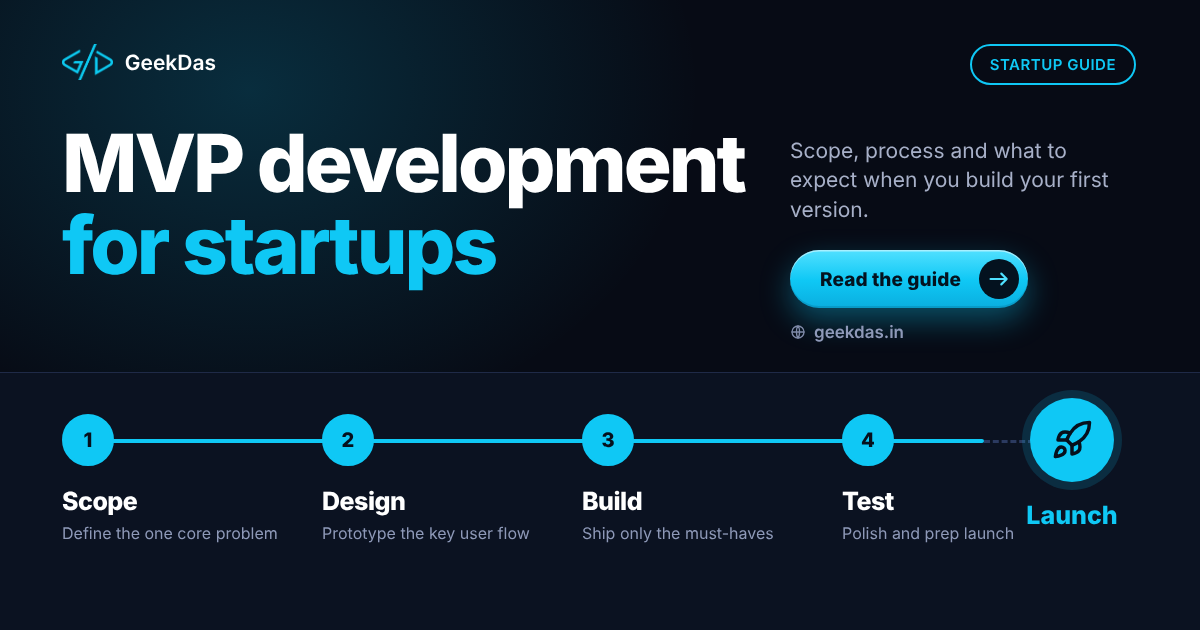
The development process, step by step
A well-run MVP usually follows these stages.
Scoping session. Define the core assumption, target user, must-have features and the success measure.
User flows and a clickable plan. Sketch the screens and the path a user takes. Changes at this stage cost almost nothing; the same change after coding is expensive.
Technical foundations. Choose a stack that can grow, set up the repository, database, authentication and deployment so every later step ships to a real environment.
Build in short cycles. Ship working slices every week or two so you can see and test real software, not wait for a final reveal.
Analytics and feedback. Add basic event tracking so you can see what users do, and a simple way for them to contact you.
Launch to a small group. Start with a limited audience, fix what breaks, then widen.
Review and plan next steps. Compare results with your success measure and decide what to build, change or drop.
For the full range of what a developer can cover in this process, see MVP development for startups on GeekDas.
Technologies for an MVP
A good MVP stack is boring on purpose: well-supported, easy to hire for and quick to change.
Frontend: React or Next.js
Backend: Node.js (Express or NestJS) or Laravel
Database: PostgreSQL or MySQL
Payments: a hosted checkout from a major gateway rather than a custom payment form
Hosting: a managed platform or a single small cloud setup you can scale later
Avoid architecture designed for millions of users. A single, well-structured application is easier to build and change in the first year than a set of microservices. For help weighing the backend options, see Node.js vs Laravel.
Web, mobile or both?
If your audience is mostly on phones, you may feel pressure to build a mobile app first. In most cases a responsive web app is faster and cheaper to test. A mobile MVP makes sense when the core value depends on device features such as the camera, push notifications or offline use. The trade-offs are covered in the cross-platform mobile app guide, and the mobile route is offered as mobile app MVP development.
Cost and timeline
Cost depends almost entirely on scope, so a reliable figure is only possible after scoping. The main drivers are:
The number of distinct workflows the user can perform
Whether you need payments or subscriptions
Third-party integrations (messaging, maps, CRMs)
Real-time features such as live updates or chat
The amount of custom design required
Whether you also need an admin area
For planning, the timelines on GeekDas service pages are a useful reference: a focused web MVP usually takes 4 to 8 weeks, and a mobile MVP about 6 to 10 weeks. Your project could fall outside these, so treat them as starting points for the scoping discussion rather than guarantees.
Ask for a fixed estimate against a written feature list, and agree in advance how changes will be handled. That protects both sides.
Common mistakes to avoid
Building for imaginary users. Talk to potential customers before writing code. Five good conversations beat a long feature list.
Feature creep. Every "while we are at it" addition delays learning.
Skipping analytics. If you cannot see what users do, you are guessing again.
Throwaway code. A rushed MVP that must be rebuilt doubles the cost. Build lean, but build to extend.
Perfecting the design. Clarity matters more than polish at this stage.
No plan for after launch. Decide who responds to feedback and who fixes bugs before you go live.
Overbuilding the admin. Start with the views you need to operate the product, not a full back office.
Choosing who builds your MVP
You have several options: a technical co-founder, a freelancer or solo developer, an agency, or a no-code tool. No-code is excellent for validating simple workflows, and many startups should try it first. Move to custom development when you need unusual logic, performance, custom integrations or control over the data.
When you compare custom development partners, look at how they handle scope, whether they will tell you what to leave out, and whether you own the code. A longer checklist is in how to choose a SaaS development partner. For a one-person full stack option, the trade-offs are covered in the full stack developer hiring guide.
Working with GeekDas on an MVP
GeekDas is a one-developer practice based in Jaipur, Rajasthan, working with founders in different time zones. For an MVP that means a scoping session first, a clear written plan, short build cycles with working previews, and a handover of the full source code and documentation. The structure suits founders who want direct access to the person writing the code. If your product needs a larger team working in parallel, I will tell you at the scoping stage.
Conclusion
A good MVP is small, honest and fast. It tests one assumption, ships in weeks rather than months, and leaves you with a codebase you can build on. Define the core assumption, cut everything that does not test it, instrument the product, and let user behaviour decide what comes next.
If you have an idea and want a realistic scope and timeline, send me a short brief and we can work out the smallest version worth building.
Was this article helpful?
Comments
Leave a comment
Loading comments...