

Node.js vs Laravel: Which Backend Should You Choose in 2026?
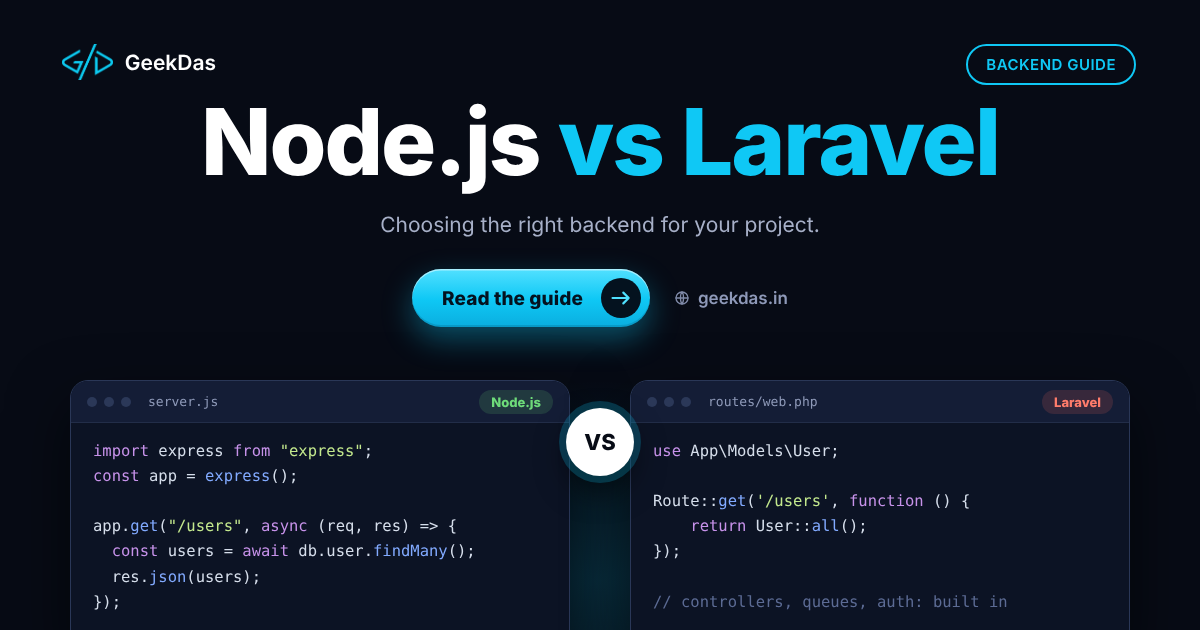
The backend decides how reliably your product stores data, handles payments, talks to other systems and scales. Two of the most common choices for web products are Node.js (typically with Express or NestJS) and Laravel, a PHP framework. Both are mature, widely used and capable of running serious products, so the decision is rarely about "which is better" and more about "which fits".
This guide compares them across the factors that matter in practice, explains when each is the stronger choice, and gives a short decision process. It is written for non-specialists but is technically accurate enough for developers to follow.
What each one is
Node.js is a JavaScript runtime that lets you run JavaScript on the server. It is not a framework by itself. You typically add Express (minimal and flexible) or NestJS (structured and opinionated, TypeScript-first) and choose libraries for the rest.
Laravel is a full-featured PHP framework with conventions for routing, database access (Eloquent ORM), authentication, queues, validation, email, scheduling and testing built in. It aims to make common tasks quick and consistent.
Side-by-side comparison
Factor | Node.js (Express or NestJS) | Laravel |
|---|---|---|
Language | JavaScript or TypeScript | PHP |
Style | Flexible assembly of libraries; NestJS is structured | Convention-driven, batteries included |
Speed of building a conventional business app | Good, more decisions to make | Excellent, many features out of the box |
Real-time features (live updates, chat) | Strong fit, event-driven | Possible with extra tooling, such as websockets services |
Shared language with front end | Yes, one language across the stack | No |
Database tooling | Prisma, TypeORM, Sequelize and others | Eloquent ORM, migrations built in |
Background jobs and queues | Via libraries | Built in |
Authentication | Libraries or custom | Built-in starter options |
Learning curve | Depends on the chosen libraries | Gentle and well documented |
Ecosystem | npm, very large | Composer and Packagist, large and curated |
Hosting | Node.js hosting, containers | PHP hosting is widely available and inexpensive |
Typical team | JavaScript and TypeScript developers | PHP developers |
Performance
Both can handle large amounts of traffic when designed properly. Raw benchmark comparisons are rarely decisive for business applications, because most delays come from the database, network calls and inefficient queries rather than the language.
Node.js is good at handling many concurrent connections, such as chat or live dashboards, because of its non-blocking, event-driven model.
Laravel handles typical request-response applications well, and with caching and queues scales for many products.
For CPU-heavy tasks (video processing, complex computation), neither is ideal; move that work to background workers or specialised services.
Choose on the shape of your workload and your team's skill, not on a benchmark.
When Node.js is the better choice
You need real-time features such as live notifications, chat or collaborative editing.
Your front end is React or Next.js and you want one language end to end, with shared types and validation.
You are building a mobile app with React Native and want the same language on the API.
You prefer TypeScript with strongly structured code through NestJS.
Your team already knows JavaScript.
Real-time messaging products, such as the WhatsApp automation platforms with team inboxes and flow builders that GeekDas has worked on, are the kind of problem where an event-driven Node.js backend fits naturally.
When Laravel is the better choice
You are building a conventional business application: admin panels, CRUD-heavy tools, portals and content systems.
You want to move fast with built-in features: authentication, queues, scheduling, mail and validation.
Your team or hosting environment is PHP-based, or you are extending an existing PHP or WordPress ecosystem.
You want a framework with strong conventions, so any Laravel developer can understand the code quickly.
Budget-friendly PHP hosting is a requirement.
For many admin tools and internal systems, Laravel is hard to beat for build speed; see admin dashboards and internal tools.
Security
Both frameworks have strong security practices when used correctly, and both can be misconfigured.
Concern | Node.js | Laravel |
|---|---|---|
Input validation | Libraries (for example express-validator) | Built-in validation |
SQL injection | Use an ORM or parameterised queries | Eloquent and the query builder parameterise by default |
CSRF protection | Add middleware as needed | Built in for web routes |
Authentication | Choose and configure libraries carefully | Built-in options |
Dependency risk | Large dependency trees need monitoring | Smaller, but still needs updates |
The framework matters less than discipline: validate input, check permissions on the server, rate-limit sensitive endpoints, keep dependencies current and never log secrets. These principles apply equally to both.
Hiring and maintenance
Node.js draws on the very large pool of JavaScript and TypeScript developers, and full stack developers can often work on both ends.
Laravel has a large, mature PHP community with strong conventions that make onboarding easy.
Whichever you choose, prefer mainstream versions and common libraries so that future developers can pick the project up.
If you plan to hire, the full stack developer hiring guide and guide to hiring a Next.js developer cover the process.
Cost considerations
Neither framework has a licence cost. The differences are indirect:
Development speed for your particular product
Hosting: PHP hosting can be cheap; Node.js hosting is also affordable but may need containers or a managed platform
Developer availability and rates in your market
Long-term maintenance: upgrades, security patches and dependency management
The cheapest option is the one your developer is strongest in and that matches the product's needs.
What about microservices and other options?
Do not let this decision push you into complexity. A single, well-structured application in either framework is the right start for most products, and splitting services later is possible when there is a clear need. Other backends (Python with Django or FastAPI, Ruby on Rails, Go, Java and .NET) are also excellent; the point of this comparison is the two most common choices for web products built by small teams.
A simple decision process
Does the product need heavy real-time behaviour? Lean Node.js.
Is it mostly forms, tables, workflows and admin? Lean Laravel.
Is your front end React, Next.js or React Native? Node.js gives you language sharing.
What does your team or chosen developer know best? That usually decides it.
Do you have existing PHP systems or hosting? Laravel fits naturally.
Are you unsure? Choose the one with the stronger match on points 4 and 5, and keep the code modular.
Common mistakes
Choosing by trend or benchmark instead of fit.
Mixing stacks without reason, creating a maintenance burden.
Skipping structure in Node.js. Without conventions, projects can become inconsistent; consider NestJS or clear project rules.
Ignoring queues and background jobs for slow tasks.
Neglecting API documentation and tests.
Over-engineering with microservices too early.
Working with GeekDas
GeekDas builds backends in both Node.js (Express and NestJS) and Laravel, on PostgreSQL and MySQL, and recommends one based on requirements and team rather than preference. API work includes schema design, authentication, validation, integrations, webhook handling and documentation; see API and backend development. For payment integrations specifically, the payment gateway integration guide covers what the backend must handle.
Conclusion
Node.js and Laravel are both reliable foundations. Choose Node.js when real-time behaviour or a shared JavaScript stack matters, and Laravel when you want a convention-driven framework for conventional business software. In practice, the strongest factor is the skill of the people who will build and maintain it.
If you are choosing a stack for a specific product, share what you are building and I will recommend one with my reasoning.
Was this article helpful?



Comments
Leave a comment
Loading comments...