

How to Hire a Next.js Developer: Skills, Questions and Red Flags
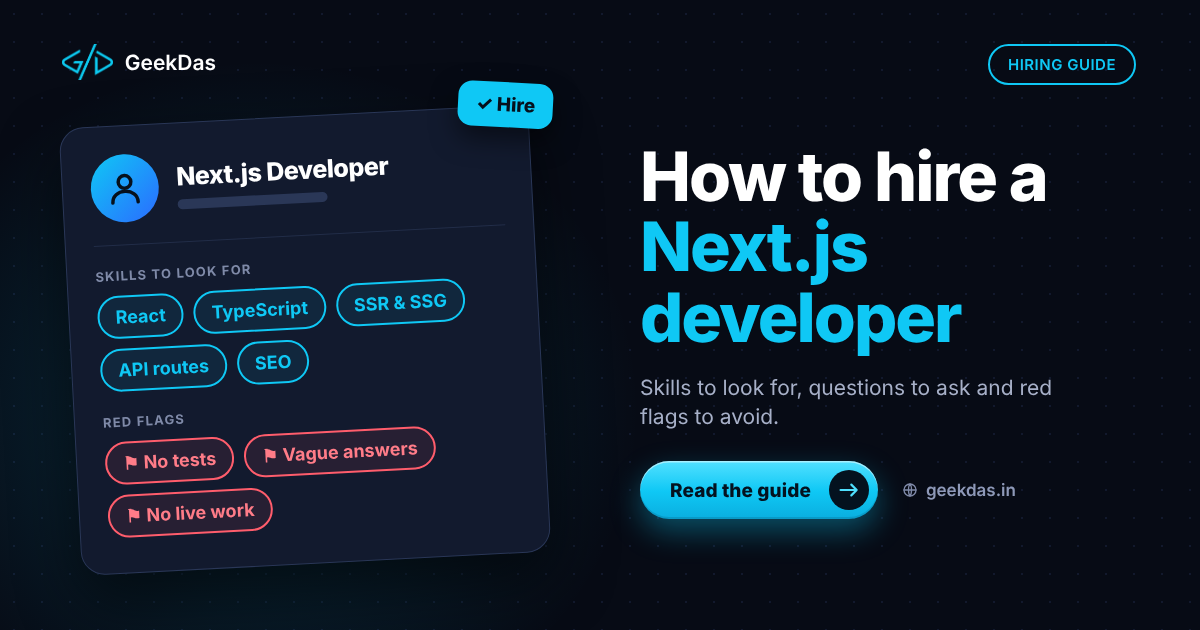
Next.js has become a default choice for production React applications, and that popularity creates a hiring problem: plenty of developers list it on a CV, but far fewer understand what makes it different from plain React. The gap shows up later as slow pages, poor search visibility, confusing data fetching and a codebase that fights the framework.
This guide helps you hire a Next.js developer deliberately. It covers when Next.js is the right tool, the skills that actually matter, interview questions with what a good answer sounds like, engagement models, and the mistakes that cost teams the most. If your search is broader than one framework, the full stack developer hiring guide covers hiring models in general.
Next.js vs React: what you are really hiring for
React is a library for building user interfaces. Next.js is a framework built on React that adds routing, server rendering, data fetching, image handling, caching and build tooling. A React developer can learn Next.js quickly, but an experienced Next.js developer brings decisions about where code runs and when it renders.
Plain React (single-page app) | Next.js | |
|---|---|---|
Rendering | Mostly in the browser | Server, static or client, per page or component |
SEO | Needs extra work; content is built in the browser | Pages can be delivered as ready-made HTML |
Initial load speed | Depends on JavaScript bundle | Can be much faster with server rendering |
Routing | Add a library | Built in (file-based) |
Backend logic | Separate server | Route handlers and server actions available |
Best for | Logged-in dashboards where SEO is irrelevant | Marketing sites, stores, content, SaaS front ends |
Choose Next.js when public pages must rank in search, when first-load speed matters, or when you want one framework covering both pages and light backend logic. A logged-in-only internal tool may not need it.
What a strong Next.js developer knows
Framework fundamentals
The App Router, layouts, nested routes, loading and error states
The difference between server components and client components, and when each is appropriate
Rendering strategies: static generation, server-side rendering and revalidation
Data fetching and caching, including how to avoid stale or over-fetched data
Metadata, sitemaps, canonical URLs and structured data for SEO
Performance and quality
Core Web Vitals (LCP, INP, CLS) and how code choices affect them
Image and font optimisation, bundle size control and code splitting
TypeScript, testing basics and linting discipline
Beyond the frontend
Building APIs with route handlers or a separate Node.js service
Authentication patterns and secure handling of tokens and sessions
Databases such as PostgreSQL or MySQL and an ORM
Deployment, environment configuration and CI
The last group matters if you want one developer to own a feature end to end. That is the premise of hiring a Next.js and React developer who can also work on the backend.
Questions to ask in an interview
Practical questions reveal more than trivia. Here are some, with what to listen for.
1. "When would you use a server component and when a client component?"
A good answer: server components for data fetching and non-interactive UI to reduce shipped JavaScript; client components only where interactivity or browser APIs are needed. A weak answer treats them as interchangeable.
2. "A page is slow. Where do you start?"
Look for a method: measure first (Lighthouse, real-user data), identify the largest element and heavy scripts, then fix images, fonts, third-party scripts and rendering strategy. Be wary of guesses with no measurement.
3. "How do you make sure a Next.js site is indexed correctly?"
Expect metadata per page, canonical URLs, a sitemap, structured data, proper status codes and avoiding content that depends on client-only rendering.
4. "How do you handle authentication and protected routes?"
Listen for server-side session checks, secure cookies, and awareness that hiding a button in the UI is not security.
5. "Tell me about a bug you found hard to track down."
The aim is to see how they reason. Strong candidates describe hypotheses, evidence and the fix, not just the conclusion.
6. "What would you not use Next.js for?"
A trustworthy developer can name cases where another tool is better. That honesty is a good sign.
Engagement models
Model | Best for | Watch out for |
|---|---|---|
Fixed-scope project | A defined build such as a marketing site or storefront | Scope changes need a clear process |
Part-time contract | Ongoing improvements, performance and SEO work | Agree a regular availability pattern |
Full-time contract | A core product with continuous development | Set clear expectations on hours and overlap |
Audit plus fixes | An existing app that is slow or messy | Agree what is included in the audit |
If you are not sure which fits, a short paid audit of the existing code is a low-risk way to start.
Where to find candidates
Direct referrals and professional networks tend to give the highest quality.
Freelance marketplaces offer volume but need careful screening.
Specialist practices such as GeekDas offer a developer who is already vetted by their public work.
Open source and personal projects are useful evidence: ask to see real, live sites, not just screenshots.
Whichever route, ask to see production sites and check their performance and indexing yourself.
Costs and what affects them
Rates vary by experience, location, engagement type and scope, so a single global number would mislead. Factors that move cost:
Seniority and breadth (frontend only vs full stack)
Project complexity and integrations
Availability and time-zone overlap
Contract length and urgency
Whether design, SEO and backend are included
Hiring a developer in India often costs less than hiring locally in the US, UK or EU, while the quality range is wide, so evaluate the individual rather than the country. See also outsourcing software development to India for how those projects run in practice.
Common hiring mistakes
Hiring for "React" and expecting Next.js knowledge. They overlap but are not the same skill set.
Judging by a CV, not live work. Ask for production URLs.
Skipping a short paid trial. A small paid task shows communication and quality before a large commitment.
Ignoring SEO and performance. These are the main reasons to choose Next.js, so test for them.
No code ownership clause. Keep ownership of the repository and accounts.
Over-engineering. A developer proposing complex architecture for a simple site should raise questions.
Red flags
Cannot explain the rendering mode of pages they built
No live examples they can point to
Guarantees search rankings
Resists using your repository and deployments
Vague availability and communication habits
Migrating or rescuing an existing project
Many hires start with a problem rather than a blank page: a slow site, an old Next.js version or a move away from WordPress. For migrations, see migrating from WordPress to Next.js without losing SEO. For a slow site, the redesign and Core Web Vitals guide explains what to measure first.
Why GeekDas
GeekDas is a full stack developer practice based in Jaipur, Rajasthan, with more than five years of experience building production frontends and the backends behind them. Next.js has been used for e-commerce storefronts, a WhatsApp marketing SaaS, a link-in-bio platform and a large set of developer tools, including this site's own free tools. You work with one developer who can take a feature from design to deployment, and who will tell you when a simpler approach is a better fit.
Conclusion
Hiring a Next.js developer well comes down to evidence: live sites, clear reasoning about rendering and performance, honest trade-offs and clean communication. Test those with practical questions and a small paid task before committing to a long engagement.
If you want to discuss a project, share the scope and timeline and I will reply with availability and a suggested approach.
Was this article helpful?



Comments
Leave a comment
Loading comments...