

Multi-Tenant SaaS Architecture: Models, Trade-offs and Data Isolation
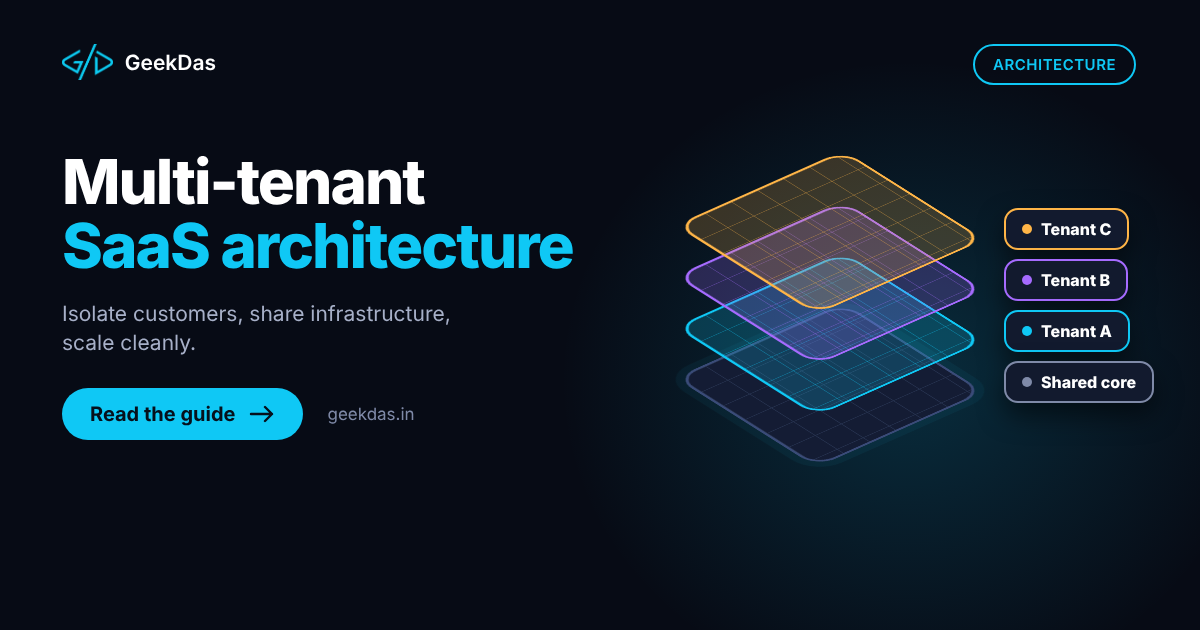
In a SaaS product, many customers use the same application at the same time, and each must see only their own data. That requirement, called multi-tenancy, is among the earliest architectural decisions you make, and among the most expensive to change later. A product that mixes customer data because of one missed filter is not a bug to fix quietly; it is a breach of trust.
The SaaS roadmap introduces the idea in one step. This article goes deeper. It explains the main tenancy models, how to isolate data safely, how tenancy affects billing, performance, migrations and backups, and how to choose a model for your product. It is written for founders and developers, with enough detail to evaluate a design.
What is a tenant?
A tenant is a customer account, usually a company or team, whose users and data are logically separated from every other customer's. A tenant has its own users, settings, data and often its own plan and limits. In a consumer product the "tenant" may simply be an individual user. Decide early what a tenant means for your product, because everything hangs off it.
Single-tenant vs multi-tenant
Single-tenant | Multi-tenant | |
|---|---|---|
Deployment | Separate instance per customer | One shared application serves all |
Cost per customer | Higher | Lower |
Operations | Many deployments to update and monitor | One to operate |
Isolation | Strongest, physical | Logical, must be designed and enforced |
Customisation | Easier per customer | Needs configuration and feature flags |
Typical use | Regulated or very large enterprise customers | Most SaaS products |
Most SaaS products start multi-tenant for cost and speed, and may offer a single-tenant deployment later for specific enterprise customers.
The three database tenancy models
1. Shared database, shared schema
All tenants' rows live in the same tables, each row carrying a tenant_id. Every query is filtered by tenant.
Pros: simplest, cheapest, easy to operate, scales to many small tenants, easy cross-tenant analytics for you.
Cons: isolation depends entirely on correct filtering; one tenant's heavy usage can affect others; per-tenant backup and restore is harder; data deletion requires careful queries.
2. Shared database, schema per tenant
Each tenant has its own schema (a namespace of tables) inside one database.
Pros: stronger separation, easier per-tenant export and deletion, per-tenant customisation possible.
Cons: migrations must run across every schema; the number of schemas can become unwieldy at large scale; tooling and ORMs need support.
3. Database per tenant
Each tenant gets a separate database.
Pros: strongest isolation, per-tenant backup, restore and data residency, easy to move a tenant to a different server, simplest to reason about for security audits.
Cons: highest operational overhead and cost, complex migration orchestration, connection management across many databases, harder cross-tenant reporting.
Comparison
Factor | Shared schema | Schema per tenant | Database per tenant |
|---|---|---|---|
Isolation strength | Logical (needs enforcement) | Stronger | Strongest |
Cost at many small tenants | Lowest | Moderate | Highest |
Operational complexity | Lowest | Moderate | Highest |
Migrations | One run | Per schema | Per database |
Per-tenant backup and restore | Hard | Moderate | Easy |
Noisy neighbour risk | Highest | Moderate | Lowest |
Data residency by tenant | Hard | Hard | Possible |
Best for | Early-stage, many small customers | Mid-sized customer base needing separation | Few large, regulated or high-value customers |
A pragmatic path: begin with a shared schema, enforce isolation rigorously, and design so that moving a large tenant to its own database later is possible.
Enforcing isolation
Choosing a model is the easy part. The hard part is guaranteeing that a query can never cross tenants.
Always carry the tenant context
Determine the tenant from the authenticated session or token on the server, never from a value the client can freely change. Attach it to every request context.
Central enforcement, not scattered filters
Relying on every developer to remember WHERE tenant_id = ... in every query is fragile. Safer approaches:
Row-level security (RLS) in databases such as PostgreSQL, where the database itself applies tenant rules to each query based on a session setting. This provides a strong safety net even if application code forgets a filter.
Data access layer or ORM middleware that automatically adds the tenant filter and refuses queries without a tenant context.
Composite keys and constraints that include the tenant, such as unique indexes on (
tenant_id,email), preventing cross-tenant collisions.
Use more than one layer where the stakes warrant it.
Test isolation explicitly
Write automated tests that create two tenants and verify that every endpoint refuses to read or write the other's data, including by guessed IDs. Add these tests to your continuous integration.
Beware the leaks outside the database
Tenant data can leak through:
Caches keyed without the tenant
File storage paths and public URLs
Search indexes
Background jobs and queues that lose the tenant context
Logs and error reports containing customer data
Analytics and exports
Admin tools used by your own staff
Apply the tenant boundary consistently to each.
Identity, roles and access
Tenancy and identity interact:
A user may belong to one tenant or several. Decide which, since it shapes login, invitations and switching.
Roles and permissions are usually per tenant (owner, admin, member, viewer).
Invitations and domains: how users join a tenant, and whether email domains map to tenants.
Single sign-on is often requested by larger customers; plan for it even if you ship later.
Support access: if your staff can view tenant data, log and limit it, and make it visible to the customer where appropriate.
Billing and plans
Billing is attached to the tenant:
Each tenant has a plan, trial and subscription state.
Usage limits (seats, records, API calls) are checked per tenant and enforced where users act, not only on the front end.
Feature gating by plan should be checked on the server.
Billing events from your payment provider are matched to tenants via webhooks. Handling these reliably, including retries and duplicates, is covered in the payment gateway integration guide.
Performance and the noisy neighbour problem
In shared infrastructure, one tenant's heavy usage can slow others down. Mitigations:
Rate limits and quotas per tenant
Indexes that start with the tenant column, so queries stay efficient as data grows
Background processing for heavy jobs, with per-tenant fairness
Pagination and sensible limits on list endpoints
Monitoring per tenant to spot outliers
The option to isolate large tenants onto separate resources
Migrations, backups and data lifecycle
Migrations: with a shared schema, one migration updates everyone, so test on realistic data and plan zero-downtime changes. With schema or database per tenant, build tooling that applies migrations to all tenants and reports failures.
Backups and restore: with a shared schema, restoring one tenant's data to a past point is difficult. If this matters, design export and restore capabilities early.
Deletion and retention: support deleting or exporting a tenant's data to meet customer requests and applicable privacy law. Know where every copy lives, including backups, logs and third-party tools.
Data residency: some customers require their data to stay in a region. This usually pushes toward separate databases or regional deployments for those customers.
Customisation per tenant
Customers will want differences: branding, fields, workflows. Prefer configuration and feature flags stored per tenant over forked code or per-tenant branches. Keep the codebase single and the differences data-driven. Offering custom code for individual customers is a path to an unmaintainable product.
Choosing a model: a decision guide
Who are your customers? Many small teams favour shared schema. A few large or regulated customers favour isolated databases.
What are your compliance needs? Data residency, audit and certification demands push towards stronger isolation.
How large will each tenant's data be? Very large tenants may need their own resources.
What can your team operate? More isolation means more operations work.
What is your stage? Early products benefit from the simplest model that is safe.
For most early-stage products, a shared schema with strict enforcement, row-level security where available, and a clear path to isolating large tenants later is the sensible starting point. This agrees with the advice in the SaaS roadmap to avoid over-engineering the first version.
Technologies
A typical stack for a multi-tenant SaaS:
PostgreSQL (or MySQL) for relational data, with row-level security where supported
Node.js (Express or NestJS) or Laravel for the backend; see Node.js vs Laravel
Next.js or React for the interface
Redis or similar for caching and queues, with tenant-aware keys
Object storage with tenant-scoped paths and signed URLs
Common mistakes
Deciding tenancy late, after the schema is built.
Trusting a tenant ID sent by the client.
Relying on developers to remember filters.
Forgetting caches, files and background jobs.
Skipping cross-tenant tests.
Per-tenant code forks.
No plan for large tenants, deletion or export.
Over-isolating too early, creating operational burden before there is revenue.
Working with GeekDas
GeekDas builds SaaS products as a one-developer practice in Jaipur, Rajasthan, including accounts, workspaces, role-based access, billing and admin back offices, on stacks such as Next.js, Node.js or Laravel and PostgreSQL. See the SaaS development service for scope and timelines, and how to choose a SaaS development partner for evaluating any provider. For a more general view on bespoke applications, see the custom web application development guide.
Conclusion
Multi-tenancy is a design decision that rewards early thought: define what a tenant is, choose the simplest model that is safe for your customers, enforce isolation centrally and test it explicitly, and design so that you can give large or regulated customers stronger separation later. Get this right and growth is a matter of scale rather than rework.
If you are designing a SaaS data model and want a second opinion, share your plans and I will give you practical feedback.
Was this article helpful?
Comments
Leave a comment
Loading comments...