

RAG Chatbot Development: How It Works and How to Build One Right
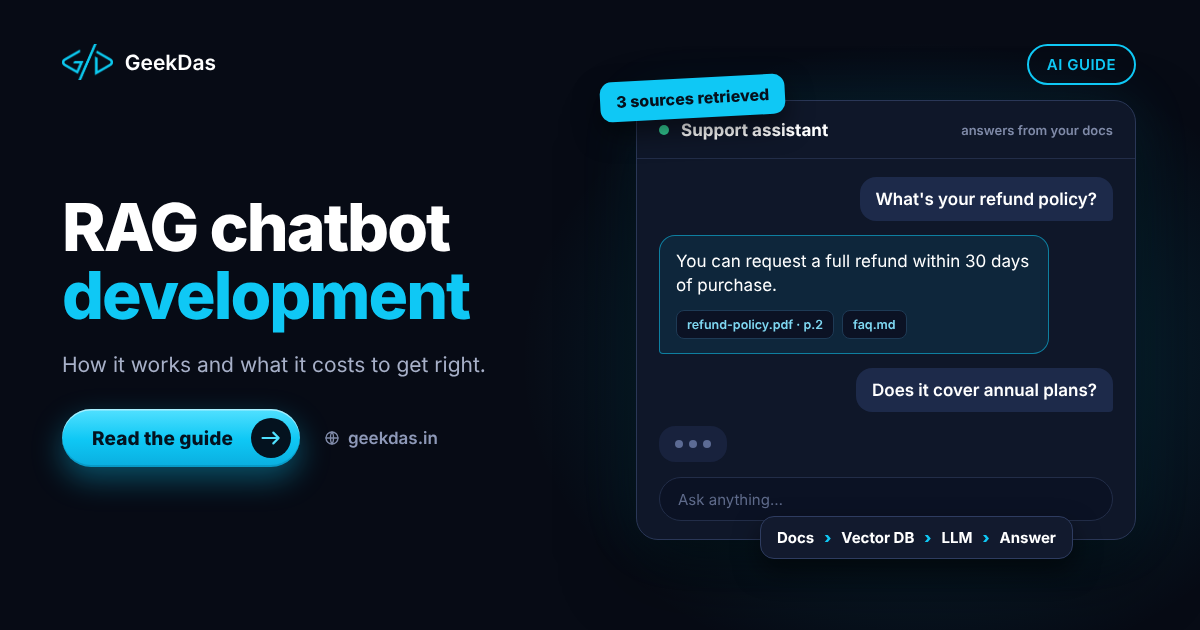
A general-purpose AI model knows a great deal about the world and nothing about your business. Ask it about your refund policy, your product's configuration options or last quarter's pricing and it will either say it does not know or, worse, answer confidently and wrongly. A retrieval-augmented generation (RAG) chatbot fixes this by looking up your own content first and answering from it.
This article explains how RAG works in plain language, when it is the right approach, the stages of building one, how to measure whether it is any good, and where the real risks and costs sit. It is written for people deciding whether and how to build a chatbot over their own documents.
What is a RAG chatbot?
RAG stands for retrieval-augmented generation. The chatbot does two things for every question:
Retrieve: it searches your documents, help centre or database for the passages most relevant to the question.
Generate: it gives those passages to a language model and asks it to answer using only that material.
The result is an assistant whose answers are tied to your content, can show their sources, and can be updated by changing the documents rather than retraining a model.
RAG vs fine-tuning vs a plain prompt
Approach | What it does | Good for | Weak at |
|---|---|---|---|
Plain prompt to a general model | Answers from the model's general knowledge | Writing, summarising text you paste in | Anything specific to your business |
Long prompt (paste everything in) | Includes all content in every request | Very small knowledge bases | Cost, latency and limits as content grows |
RAG | Retrieves relevant passages per question | Support, internal knowledge, product Q&A, changing content | Needs good content, retrieval tuning and evaluation |
Fine-tuning | Adjusts model behaviour using examples | Tone, format and task-specific style | Adding new facts reliably; keeping facts current |
In practice, RAG is the default starting point for "answer from our documents". Fine-tuning is better thought of as a way to change how a model responds, not what it knows.
When a RAG chatbot is a good idea
Customers or staff ask the same questions repeatedly and answers exist in writing.
Your documentation is large or changes often.
Wrong answers can be caught, and a human can take over when needed.
You want answers that cite their sources.
It is a poor fit when the source content is thin, contradictory or out of date. The chatbot can only be as good as the material it retrieves, so content cleanup is often the real first task.
How a RAG system is built
1. Collect and clean the content
Gather help articles, PDFs, policies, product data and FAQs. Remove duplicates and outdated material, and decide who owns keeping each source current.
2. Split content into chunks
Documents are divided into passages small enough to be retrieved precisely, but large enough to keep their meaning. Chunking by headings or sections usually works better than cutting at a fixed length.
3. Create embeddings and store them
Each chunk is converted into an embedding, a numeric representation of its meaning, and stored in a vector index. PostgreSQL with a vector extension is a sensible choice if you already use PostgreSQL; dedicated vector databases exist for larger needs. Keep source metadata such as title, URL, date and access level with each chunk.
4. Retrieve at question time
The user's question is turned into an embedding and matched against the stored chunks. Strong systems often combine meaning-based search with keyword search and then re-rank results, because pure vector search can miss exact terms such as product codes.
5. Prompt the model with the retrieved passages
The prompt tells the model to answer only from the supplied passages, to say when the answer is not there, and to cite sources. This instruction is the main defence against invented answers.
6. Add guardrails and handover
Decide what the bot must refuse, how it handles sensitive topics, and when it passes the conversation to a person. A support bot without a human handover will eventually frustrate someone.
7. Evaluate and monitor
Build a set of real questions with known correct answers and measure the bot against it every time you change the content, prompts or model. Log questions it could not answer; they show exactly which content is missing.
Will the chatbot make things up?
Any language-based system can produce errors, so the aim is to reduce and manage them rather than promise zero. The practical measures are:
Restrict answers to retrieved content and instruct the bot to say "I don't know" when retrieval is weak.
Show sources so users can verify.
Keep content current and remove contradictions.
Set a similarity threshold below which the bot declines to answer.
Test regularly against a fixed question set.
Review logged conversations, especially those that were rated poorly.
Data privacy and security
Sending content to a model provider is a data-sharing decision. Consider:
Which documents should be indexed at all (exclude personal or confidential data unless required)
Access control, so that a customer cannot retrieve content meant for staff
Provider data-handling terms and settings for retention and training use
Where data is stored and any regional requirements that apply to you
Logging that avoids storing sensitive personal information unnecessarily
These should be settled in the brief, before any build begins.
Where RAG chatbots are used
Customer support: answering product and policy questions with links to the source article
Internal knowledge: HR, IT and operations questions from staff
Sales assistance: product comparison and specification lookups
SaaS products: in-app help grounded in documentation
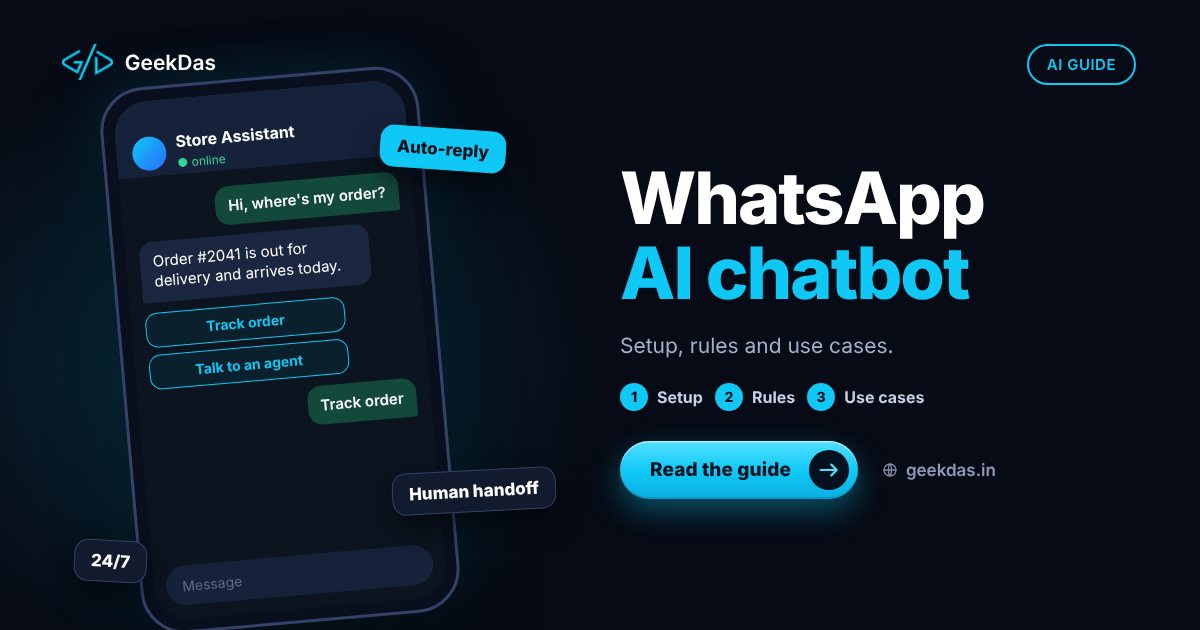
Messaging channels: the same engine can power a WhatsApp AI chatbot
GeekDas has built AI assistants and chatbots into SaaS products used for customer messaging, including WhatsApp marketing tools with AI features.
Technologies
Typical building blocks, chosen per project:
Layer | Options |
|---|---|
Language model | OpenAI or another provider, selected on quality, cost, latency and privacy terms |
Embeddings and vector search | PostgreSQL with a vector extension, or a dedicated vector store |
Backend | Node.js |
Front end | A web widget (for example in Next.js), WhatsApp or an internal tool |
Monitoring | Logging of queries, sources used, ratings and cost |
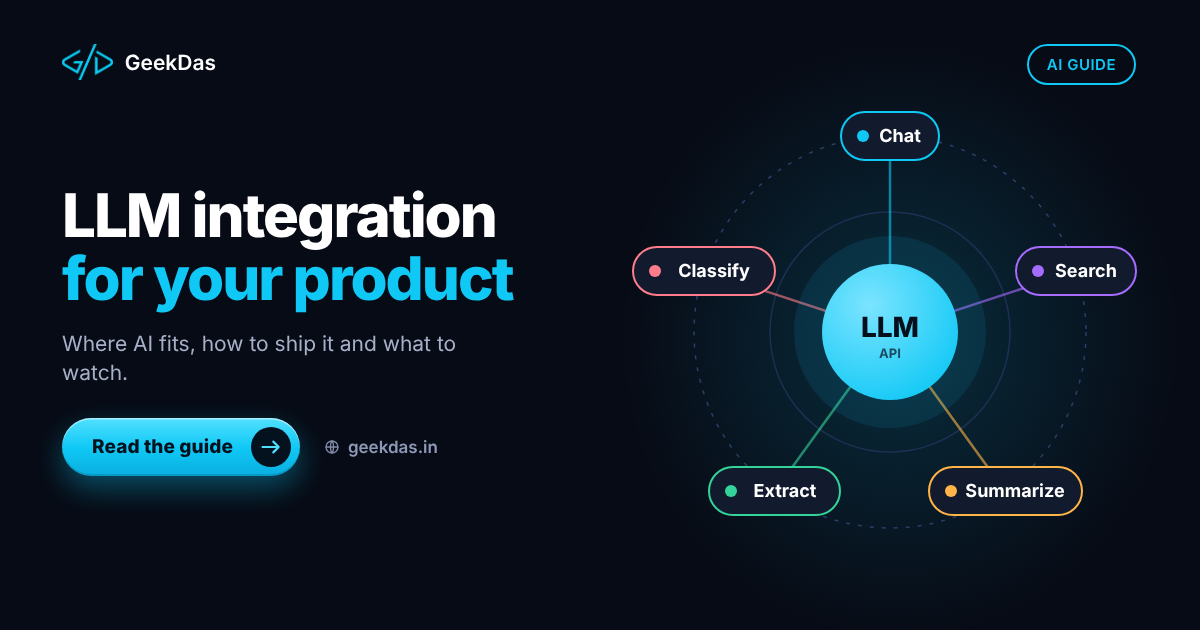
The model call is the smallest part. Retrieval quality, content hygiene and evaluation determine the outcome. For the wider topic of adding AI to an existing product, see LLM integration for your product.
Cost and timeline
Costs fall into build and running costs.
Build: scope of data sources, number of channels, access control needs, and evaluation work.
Running: model usage (which scales with traffic and prompt size), hosting, and content maintenance.
A focused chatbot over one set of documents can often be working in 2 to 4 weeks; several data sources, permission rules or agent actions take longer. Control running cost by caching common answers, limiting prompt size and logging usage per conversation. Prices for model providers change often, so check current rates when budgeting.
Common mistakes
Starting with the model, not the content. Poor documents produce poor answers.
No evaluation set. Without one you cannot tell whether a change helped.
Indexing everything. More content is not better; irrelevant passages degrade retrieval.
Ignoring permissions. A shared index can expose restricted content.
No fallback. Plan for when the model is unavailable or unsure.
Launching to everyone at once. Release to a small group, review conversations and improve.
How to choose a developer for a RAG project
Ask for specifics: how they chunk and retrieve, how they evaluate answer quality, how they handle permissions, what the fallback is, and how costs are monitored. Be cautious of anyone who promises a bot that is "never wrong" or who cannot describe how it would be tested. Consider whether they can also build the surrounding product, since a chatbot rarely lives alone. See the RAG chatbot development service for what GeekDas covers.
Why GeekDas
GeekDas is a one-developer practice in Jaipur, Rajasthan, building LLM-powered features and chatbots as part of a full stack: the data pipeline, interface, API and fallbacks, not just the model call. That works well when the chatbot must fit into an existing web product or messaging workflow. It is best suited to focused deployments; very large multi-department programmes may need a bigger team.
Conclusion
RAG is the practical route to a chatbot that knows your business. The model is only one piece; the quality of your content, the retrieval, the guardrails and the evaluation decide whether people trust the answers. Start with one well-defined use case, measure against real questions and expand carefully.
If you are considering an assistant over your own documents, tell me about the content and the audience and I will suggest a focused first version.
Was this article helpful?
Comments
Leave a comment
Loading comments...