
Custom Website Development vs Website Builders: Which Is Right?
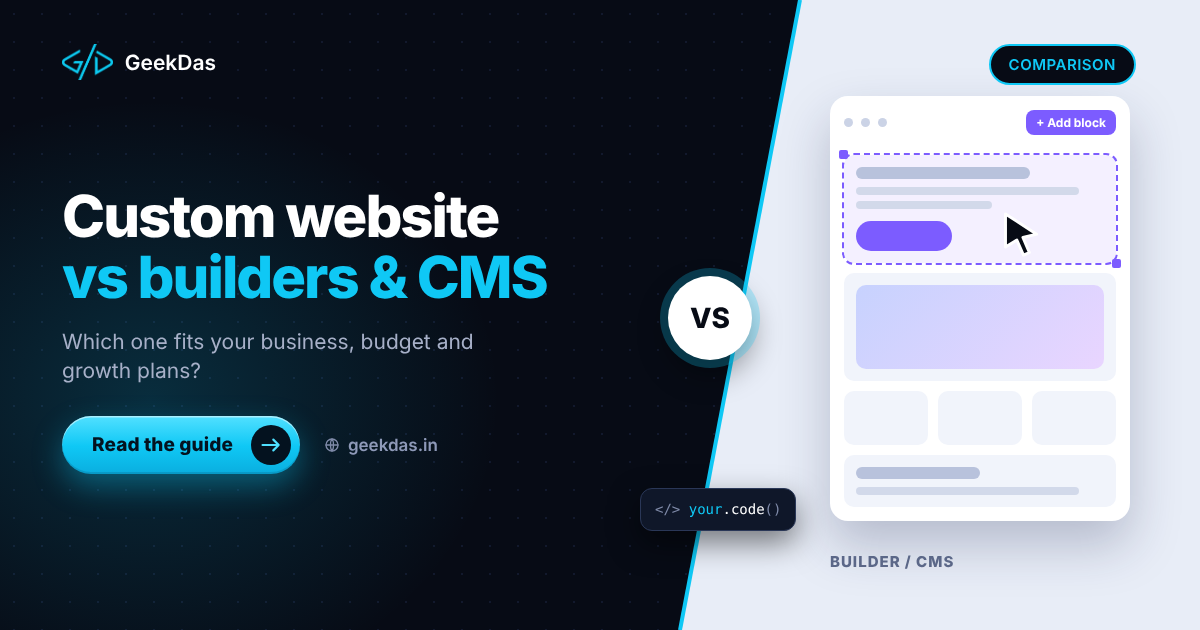
Website builders and themes have made it possible to launch a presentable site in an afternoon. That is a real advantage, and for many businesses it is the right answer. But "easy to launch" and "right for the next five years" are different questions. A site that is slow, hard to change, or costly to extend can quietly hold a business back.
This article compares custom website development with the main alternatives: hosted builders such as Wix and Squarespace, and WordPress with a theme or page builder. It focuses on what actually differs (speed, search, flexibility, ownership, cost over time) so you can decide with confidence. For pricing detail, see what a business website costs in India; this guide concentrates on the choice itself.
The three main approaches
Hosted website builders
Platforms such as Wix and Squarespace give you templates, drag-and-drop editing and hosting in one subscription. They are quick and approachable, and you do not need a developer.
WordPress with a theme or page builder
WordPress is a content management system with a huge ecosystem. You choose hosting, a theme and plugins. It is flexible, but quality depends heavily on the theme, plugins and hosting you pick.
Custom website development
A developer builds the site from scratch to your brand and requirements, typically on a modern framework such as Next.js with Tailwind CSS, optionally with a content management setup so you can edit it yourself.
Side-by-side comparison
Factor | Website builder | WordPress with theme | Custom development |
|---|---|---|---|
Time to launch | Hours to days | Days to weeks | 1 to 5 weeks for most business sites |
Upfront cost | Lowest | Low to moderate | Moderate to higher |
Ongoing cost | Monthly subscription | Hosting, premium plugins, maintenance | Hosting and optional maintenance |
Design uniqueness | Template-limited | Theme-limited, customisable | Fully tailored |
Page speed potential | Fair, often heavy | Variable, plugin-dependent | Excellent when built well |
SEO control | Basic to good | Good with effort | Full control of structure and markup |
Flexibility for custom features | Low | Moderate via plugins | High |
Security and maintenance | Handled by platform | Your responsibility (updates, plugins) | Smaller attack surface, but still needs updates |
Ownership and portability | Locked into the platform | Portable | Fully yours |
Editing by non-developers | Easy | Easy | Depends on CMS setup |
No column wins everywhere, so the best choice follows from your priorities.
When a website builder is the right choice
You need something live quickly and cheaply.
The site is simple: a few pages, a contact form.
You will update it yourself, often, with no technical help.
You are testing a business idea and may change direction.
There is no shame in this. A well-written simple site on a builder beats an over-engineered custom site that never launches.
When WordPress makes sense
You publish a lot of content and want a mature editing experience.
You need a plugin that already does what you need.
You have someone who will maintain updates and security.
WordPress sites often become slow as plugins accumulate, and that is the most common reason businesses later move to a custom build. The migration process is described in WordPress to Next.js migration without losing SEO.
When custom website development is worth it
Speed and Core Web Vitals matter. Custom sites ship only the code they need, with no theme or plugin overhead.
Search is a main acquisition channel. You control headings, structured data, URLs and rendering.
You need functionality a template cannot do. Booking, calculators, customer areas, integrations.
You want a distinctive brand presence. The design is yours, not a variation on a template.
You are tired of plugin maintenance. Fewer moving parts means fewer surprises.
You want to own everything. Code, hosting and content are yours.
The service is described at custom website development on GeekDas, including the on-page SEO and performance work normally included.
What matters most for search
Whatever you choose, search visibility depends on the same fundamentals:
Speed. Fast loading on mobile, measured by Core Web Vitals.
Structure. A logical heading hierarchy, clean URLs and internal links.
Content. Pages that answer what visitors are searching for.
Metadata and structured data. Titles, descriptions and schema that match the page.
Mobile usability. The mobile version is what Google primarily evaluates.
A custom build makes the first, second and fourth easiest to get right, because nothing is imposed by a template. But no approach guarantees rankings; content, competition and authority matter at least as much. Beware of anyone who promises a position on Google.
The real cost over three years
Price comparisons often stop at launch. A fairer comparison includes:
Cost item | Builder | WordPress | Custom |
|---|---|---|---|
Setup | Low | Low to moderate | Moderate to higher |
Subscription or hosting | Recurring platform fee | Hosting plus premium themes and plugins | Hosting |
Maintenance | Mostly included | Regular updates and security | Occasional updates |
Redesign or migration | Common when outgrown | Common when slow | Less frequent |
Cost of lost leads from slowness | Hidden | Hidden | Lower when optimised |
A custom site costs more at the start, but the total can be competitive if it prevents a rebuild. Equally, a builder may be the cheapest path for three years if your needs stay simple.
Common mistakes
Choosing by the demo. Templates look polished with sample content; your content may not fit.
Underestimating plugin maintenance on WordPress.
Over-customising a builder until it becomes slow and brittle.
Commissioning a custom site without a content plan. Design needs real text and images.
Not owning the domain and hosting account. Keep them in your name.
Ignoring mobile. Test on a real phone.
Treating SEO as an afterthought. Retrofitting it costs more than planning it.
How to choose a website developer
Ask for live sites, then test their speed on a phone.
Ask how they handle SEO basics: headings, metadata, sitemap and structured data.
Confirm who owns the code, domain and hosting.
Ask what editing you can do yourself after launch.
Get a written scope, timeline and fixed price.
Clarify what support is included after launch.
If you are comparing a freelancer with an agency, the earlier cost guide includes a table of those options. For businesses in Rajasthan, see choosing a web development company in Jaipur for local versus remote considerations.
Related decisions
A single-purpose page for ads or launches may be best as a landing page rather than a full site.
An existing site that is slow or dated may need a redesign focused on Core Web Vitals.
If you plan to sell online, start with the e-commerce website development guide.
Why GeekDas
GeekDas is a one-developer practice based in Jaipur, Rajasthan. Websites are custom coded, not assembled in page builders, with semantic HTML, structured data, fast load times and responsive layouts, and GeekDas's own site is built this way. If a builder or WordPress would serve you better, I will say so rather than sell you a custom build you do not need.
Conclusion
Choose the simplest approach that meets your real requirements. A builder suits quick, simple sites; WordPress suits content-led sites with someone to maintain them; custom development suits businesses for whom performance, search and flexibility are central. Whatever you choose, own your domain and content, and plan SEO from day one.
If you are weighing the options for a specific project, share a short brief and I will give you an honest recommendation.
Was this article helpful?
Comments
Leave a comment
Loading comments...