

Holi 2027 Date: Holika Dahan Muhurat, Story & Significance
Holi, known as the Festival of Colors, is one of the most vibrant and joyful festivals celebrated in India and across the world. From the exact Holi 2027 date to the mythological story of Prahlada and Holika, and the spiritual meaning behind the celebrations, let's explore the true essence of Holi.
When Is Holi in 2027?
In 2027, Holi will be celebrated on:
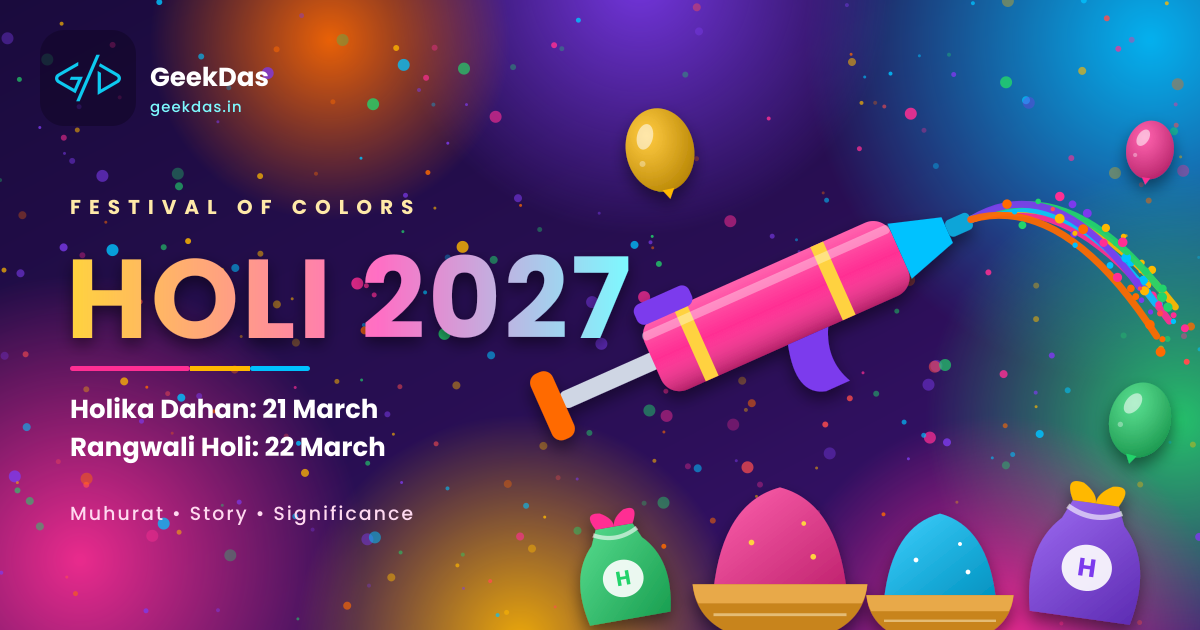
Holika Dahan (Chhoti Holi): March 21, 2027 (Sunday)
Rangwali Holi (Festival of Colors): March 22, 2027 (Monday)
Holi is celebrated on the full moon day (Purnima) of the Hindu month of Phalguna, which usually falls in February or March. In 2027, Phalguna Purnima begins at 6:21 PM IST on March 21 and ends at 4:13 PM IST on March 22.
The first day, Holika Dahan, involves a ritual bonfire symbolizing the burning of evil. The second day is the main celebration where people apply colors, throw gulal, dance, and share sweets.
Holika Dahan Muhurat 2027 (New Delhi)
Holika Dahan is performed after sunset, during Pradosh Kaal, while Purnima is prevailing. For New Delhi, the muhurat on March 21, 2027 is 6:33 PM to 8:55 PM, a window of about 2 hours 22 minutes. Timings vary by city, so check a local panchang for your location.
Why Holi 2027 Is Later Than Holi 2026
Holi follows the Hindu lunar calendar, so its date on the Gregorian calendar shifts every year. In 2026 it fell on March 4, while in 2027 it comes about 17 days later, on March 22.
Why Do People Celebrate Holi?
People celebrate Holi for religious, cultural, seasonal, and social reasons. The festival represents:
Victory of good over evil
Arrival of spring
End of winter
Forgiveness and new beginnings
Social harmony and unity
Let's understand these reasons in detail.
Holi Celebrates the Victory of Good Over Evil
The primary story behind Holi comes from Hindu mythology and is connected to the demon king Hiranyakashipu, his son Prahlada, and his sister Holika.
The Story Behind Holi
According to legend:
Hiranyakashipu was a powerful demon king who wanted everyone to worship him as God.
However, his son Prahlada was a devoted follower of Vishnu.
Furious at his son's devotion, Hiranyakashipu tried multiple times to kill him.
Finally, he asked his sister Holika, who had a magical shawl that protected her from fire, to sit in a burning fire with Prahlada in her lap.
Due to divine intervention, the shawl flew from Holika to Prahlada.
Holika burned to ashes while Prahlada survived unharmed.
This event symbolizes the destruction of evil (Holika) and the protection of devotion and goodness (Prahlada). That's why people light bonfires on Holika Dahan, to remember that truth and faith always win.
Holi Marks the Arrival of Spring
Holi also has a strong seasonal connection. It is celebrated at the end of winter and the beginning of spring.
In ancient India, this time of year marked:
The harvest season
Blooming flowers
Warmer weather
Agricultural prosperity
Throwing bright colors represents the colors of spring: flowers, nature, and happiness.
Holi Promotes Forgiveness and Unity
Holi is often called a festival of reconciliation. People:
Forgive past misunderstandings
Reconnect with friends and family
Visit relatives and neighbors
Share sweets like gujiya and thandai
The phrase commonly used during Holi is "Bura na mano, Holi hai!" It encourages playful celebration without grudges.
How Is Holi Celebrated?
Holi celebrations usually take place over two days.
Day 1: Holika Dahan (Chhoti Holi) - March 21, 2027
On the night before Rangwali Holi:
People gather wood and light a bonfire.
Prayers are offered for protection from evil.
Some families perform rituals around the fire.
Grains and coconuts are offered into the flames.
The bonfire symbolizes burning negativity and ego.
Day 2: Rangwali Holi (Dhulandi) - March 22, 2027
This is the main celebration day where:
People play with gulal (colored powder)
Water balloons and pichkaris are used
Music and dance fill the streets
Traditional sweets are prepared
Communities celebrate together in parks, temples, and public areas.
The Story of Radha and Krishna in Holi
Another popular story linked to Holi involves Krishna and Radha.
According to legend:
Krishna had a dark complexion.
He was worried whether Radha would like him.
His mother jokingly suggested he color Radha's face.
Krishna playfully applied color on Radha.
This playful act became a tradition, especially in Mathura and Vrindavan, where Holi is celebrated with grand enthusiasm.
Where Is Holi Celebrated?
Holi is mainly celebrated in India, but it is also observed in:
Nepal
Bangladesh
Mauritius
Fiji
United States (among Indian communities)
United Kingdom
Canada
Cities like Mathura and Vrindavan are famous for week-long Holi celebrations.
Different Types of Holi Celebrations in India
Holi is celebrated differently in various regions of India.
Lathmar Holi (Barsana): Women playfully hit men with sticks as part of tradition.
Phoolon Ki Holi: Instead of colors, flowers are used.
Royal Holi (Rajasthan): Celebrated with elephants and traditional processions.
Dol Jatra (West Bengal): Celebrated with songs and devotion.
Spiritual Meaning of Holi
Beyond colors and fun, Holi has deeper meaning:
Burn inner negativity (ego, anger, jealousy)
Start fresh with positivity
Embrace equality: during Holi, social barriers dissolve
Everyone becomes equal when covered in colors.
Environmental and Safe Holi Tips
Modern Holi celebrations should also focus on safety:
Use organic and herbal colors
Avoid chemical powders
Respect consent before applying colors
Avoid wasting excessive water
Protect eyes and skin
Eco-friendly Holi ensures tradition without harm.
What Is the Significance of Holika Dahan?
Holika Dahan teaches:
Arrogance leads to downfall
Faith protects the righteous
Evil intentions ultimately destroy themselves
The ritual bonfire is not just symbolic. It is spiritual cleansing.
Is Holi a National Holiday?
In India, Holi is a gazetted public holiday in most states. Schools, banks, and government offices remain closed. In 2027, Holi falls on a Monday, which makes for a long weekend for many people.
However, holiday dates may vary slightly across states, so check your state's official holiday list.
Conclusion
So, when is Holi in 2027? Holi will be celebrated on March 22, 2027, with Holika Dahan on March 21, 2027.
Holi is more than just a colorful festival. It represents:
Victory of good over evil
Devotion and faith
Joy and forgiveness
Arrival of spring
Unity and celebration
From the story of Prahlada and Holika to the playful traditions of Radha and Krishna, Holi carries deep spiritual and cultural significance.
As you prepare for Holi 2027, remember its true message: let positivity win, and let colors spread happiness.
Was this article helpful?
Comments
Leave a comment
Loading comments...