
UPI MDR Deferred Till After Diwali: What Changes Now (2026)
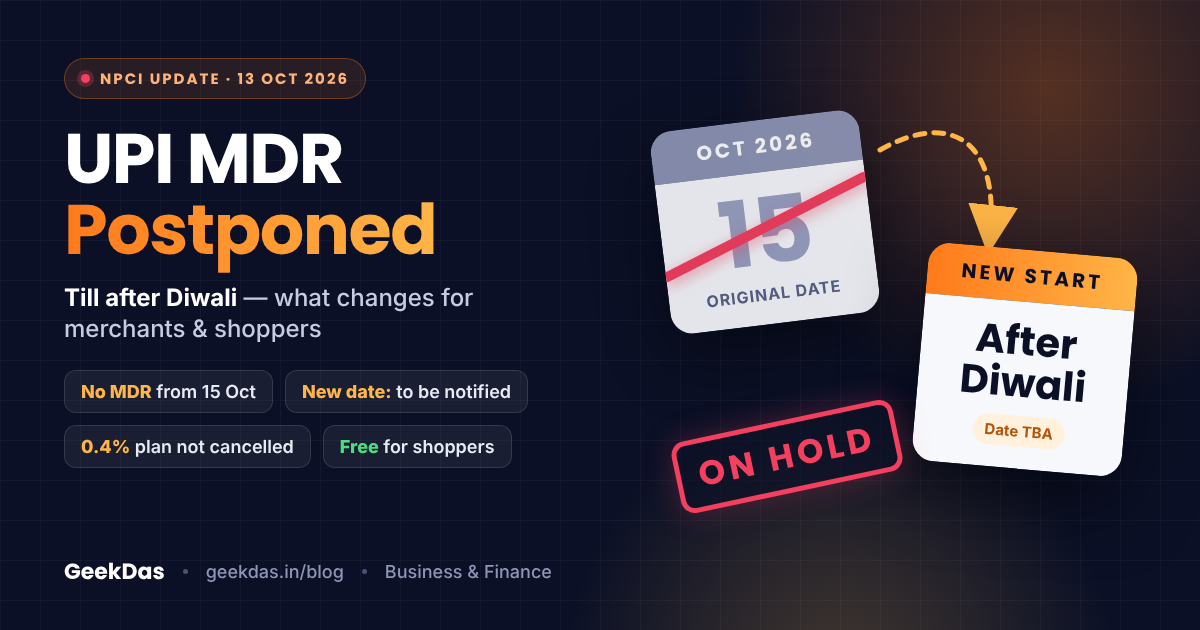
Just two days before it was due to start, the 0.4% Merchant Discount Rate (MDR) on UPI has been put on hold. On Tuesday, 13 October 2026, the National Payments Corporation of India (NPCI) announced that MDR on select person-to-merchant (P2M) UPI transactions will not begin on 15 October as planned.
According to NPCI, the charges "shall be implemented immediately post Diwali", at a date to be notified separately.
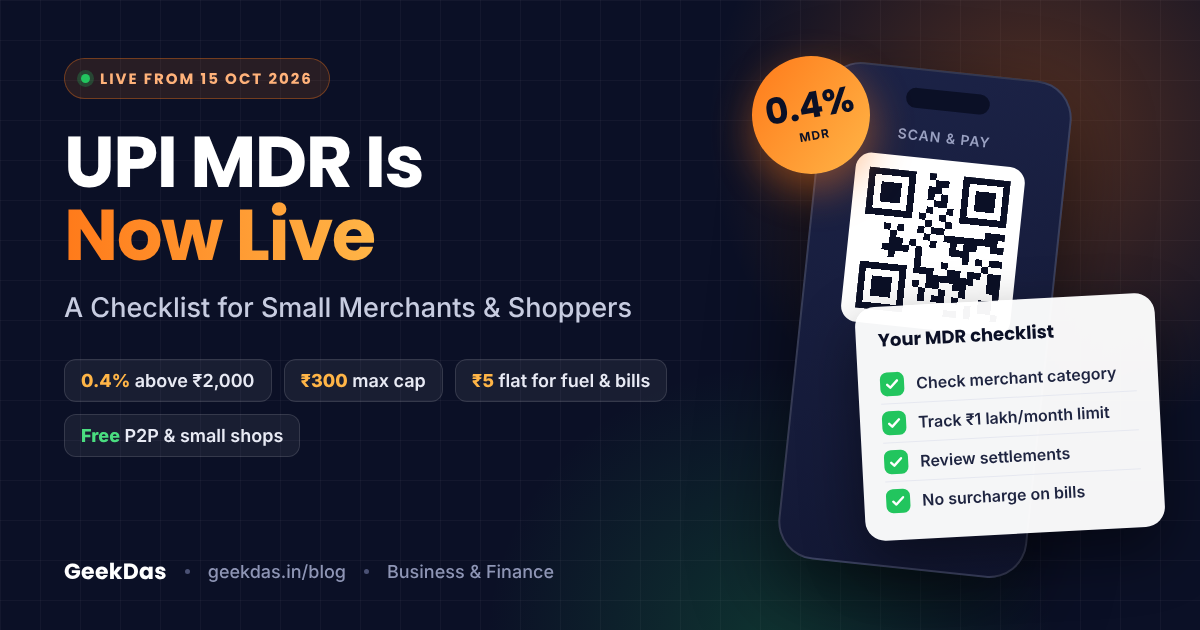
If you read our earlier explainer, UPI MDR Is Live: Checklist for Merchants & Shoppers (2026), UPI 0.4% Charges: What the New MDR Rule Means in 2026, this post tells you what has changed, what hasn't, and what merchants and shoppers should do now.
What Did NPCI Announce?
The decision came from NPCI's UPI and Services Steering Committee. The key points:
MDR on select P2M UPI transactions was scheduled to start on 15 October 2026.
It has been deferred, "keeping in mind the festive season."
It will be implemented "immediately post Diwali".
The exact new date has not been announced and will be notified separately.
Why Was It Postponed?
NPCI cited the festive season. Diwali falls on Sunday, 8 November 2026 (see our Diwali 2026 calendar), and October to November is the biggest shopping period of the year. Retailers, restaurants, e-commerce sellers and small businesses all see a sharp jump in digital payments.
Reports say merchant bodies had requested the delay over concerns about consumer sentiment during festive shopping. A merchant survey in August had already found that close to half of merchants were unwilling to pay MDR on UPI.
Is the MDR Cancelled?
No. The deferment changes the timing, not the decision. Coverage of the announcement notes that the deferment does not mean the charges have been withdrawn. The opposition has questioned whether this could lead to a full rollback, but there is no official indication of that so far.
What About the New Date?
NPCI has only said "immediately post Diwali." One report from early October said January 2027 was under consideration, but NPCI's statement does not confirm any month. Until NPCI notifies a date, treat any specific date you see online as speculation.
What Changes and What Stays the Same
What Changes
No MDR from 15 October. Merchant UPI payments above ₹2,000 continue without MDR for now.
No settlement deductions linked to the new framework until the new date is notified.
The start date is now open, to be announced separately.
What Stays the Same (So Far)
NPCI's announcement was about timing only. It did not announce changes to the framework itself, which was:
Transaction type | MDR under the announced framework |
|---|---|
Person-to-person (P2P) transfers | Free |
Merchant payments up to ₹2,000 | Free |
Small merchants (P2PM, up to ₹1 lakh/month via QR) | Free |
Merchant payments above ₹2,000 | 0.4% |
Merchant payments ₹75,000 and above | Capped at ₹300 |
Railways, telecom, insurance, fuel, agri inputs | ₹5 flat (above ₹2,000) |
Mutual funds, securities, stockbrokers | 0.02%, capped at ₹300 |
The government estimated that only about 4% of merchant transactions would be affected. Because the final rules could still be revised before rollout, check NPCI's notification when the new date is announced.
What Merchants Should Do Now
Don't Change Prices Yet
If you planned to raise prices or adjust margins from 15 October, hold off. MDR is not being charged during the festive season.
Use the Extra Time to Prepare
The delay is a free window to get ready:
Confirm your category with your bank or payment provider: P2PM (small merchant) or P2M.
Track monthly UPI receipts. Small merchants receiving up to ₹1 lakh a month via QR are exempt.
Estimate your cost using
Amount × 0.4%, counting only payments above ₹2,000, with a ₹300 cap.Ask your provider how MDR will appear in settlement reports once it starts.
Keep Accepting UPI
Refusing UPI for larger bills during Diwali could cost you sales. Since no MDR applies right now, there is no reason to steer customers to cash.
Don't Add a "UPI Surcharge"
Some merchants may already have planned a UPI fee. There is no MDR to recover right now, and even after rollout, banks have been advised that MDR should not be passed on to customers as a surcharge.
What Shoppers Should Do Now
Nothing Changes for You
UPI remains free for consumers. Even under the framework, MDR was always meant to be a merchant-side cost, not a customer fee. P2P transfers stay free at any amount.
Be Careful With Viral Messages
Expect a fresh wave of confusing forwards: "UPI is free again", "UPI charges start tomorrow", or made-up dates. Rely on NPCI, your bank or reputable news sources.
Watch for Fake "UPI Fee" Messages
Fraudsters often exploit policy news. Never pay a "UPI charge" via a link, approve an unexpected collect request, or share your UPI PIN to "avoid MDR."
Practical Examples
Example 1: Electronics Purchase During Diwali
You buy a ₹25,000 phone on 1 November using UPI.
Under the original plan: the merchant would have paid ₹100 MDR (₹25,000 × 0.4%).
Now: ₹0 MDR. You pay exactly ₹25,000.
Example 2: Sweet Shop Diwali Orders
A sweet shop receives 200 UPI orders of about ₹2,500 each during Diwali week.
Under the original plan: 200 × ₹10 = ₹2,000 in MDR.
Now: ₹0, which is a real saving in the busiest week of the year.
Example 3: Small Kirana Store
A kirana store receives ₹80,000 a month via its UPI QR.
Before and after: ₹0 either way. As a P2PM merchant, it was already exempt.
Example 4: Paying Your Friend Back for Diwali Gifts
You send ₹6,000 to a friend.
Always ₹0. P2P transfers were never part of MDR.
Common Mistakes to Avoid
Assuming MDR Is Cancelled for Good
It's postponed, not scrapped. Merchants should still plan for it.
Believing a Specific New Date From Social Media
NPCI hasn't announced one. Wait for the official notification.
Charging Customers a UPI Fee
There's no MDR right now, and surcharging customers would go against the guidance even after rollout.
Thinking Shoppers Were Ever Going to Pay
MDR was always designed as a merchant cost. Customers were never meant to be charged.
Ignoring Preparation
When rollout comes "immediately post Diwali," notice could be short. Use this window.
Benefits of the Deferment
For Merchants
No MDR during peak festive sales, which protects margins in the busiest weeks.
More time to understand categories, costs and settlement changes.
For Shoppers
Smoother festive shopping, with less risk of merchants refusing UPI or adding unofficial fees.
For the Ecosystem
Payment providers and banks get more time to test systems and communicate clearly with merchants.
Fintech stocks rebounded from their intra-day lows after the announcement, a sign that markets welcomed the clarity.
Original Plan vs Current Status
Factor | Original plan (Sept 2026) | Current status (13 Oct 2026) |
|---|---|---|
Start date | 15 October 2026 | "Immediately post Diwali", date to be notified |
MDR rate | 0.4% above ₹2,000 | No change announced |
₹300 cap | Yes | No change announced |
Small merchant (P2PM) exemption | Yes | No change announced |
₹5 flat for essential sectors | Yes | No change announced |
Charge on shoppers | None | None |
Charges during Diwali 2026 | Would have applied | Will not apply |
Conclusion
The UPI MDR is on hold, not cancelled. Here is the short version:
No MDR from 15 October. UPI merchant payments continue as before through Diwali.
Rollout comes "immediately post Diwali", on a date NPCI will announce separately.
No changes to the rates or exemptions have been announced.
Shoppers: nothing changes. UPI stays free for you.
Merchants: use this window to check your category and estimate costs.
We will update this post once NPCI announces the new date. For more fintech explainers, browse the GeekDas blog.
Disclaimer: This article reflects NPCI's announcement and news reports as of 13 October 2026. The implementation date and final rules may change. Always confirm with NPCI notifications, your bank or your payment provider.
Was this article helpful?