
UPI MDR Is Live: Checklist for Merchants & Shoppers (2026)
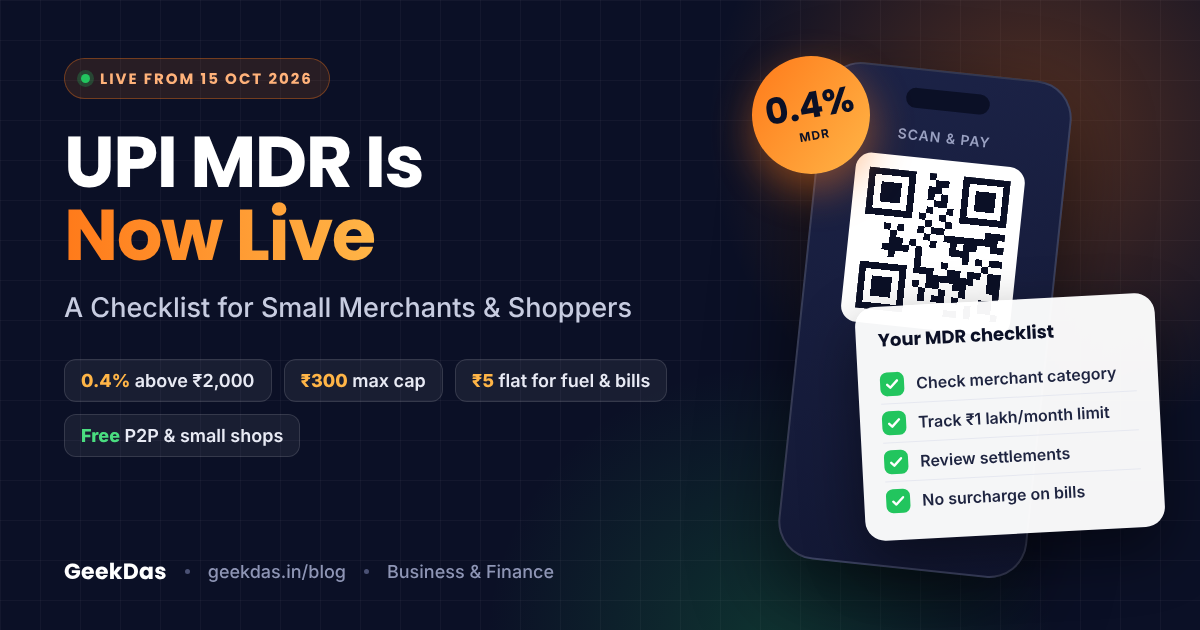
From October 15, 2026, the new UPI Merchant Discount Rate (MDR) framework is in effect. If you run a shop, you may be wondering whether your settlements will shrink. If you shop with UPI, you may have seen WhatsApp forwards claiming "every UPI payment now costs 0.4%."
The reality is far less dramatic: the government estimates the MDR will touch only about 4% of merchant transactions. We explained the rule in UPI 0.4% Charges: What the New MDR Rule Means in 2026. This guide is the practical follow-up.
UPI MDR at a Glance: What Changed on October 15
Before the checklists, here is the full rate card in one place.
Transaction type | MDR | Notes |
|---|---|---|
Person-to-person (P2P) transfers | Free | Any amount |
Merchant payments up to ₹2,000 | Free | All merchants |
Merchant payments above ₹2,000 | 0.4% | Paid by the merchant |
Merchant payments ₹75,000 and above | ₹300 cap | Charge stops rising |
Small merchants (P2PM, up to ₹1 lakh/month via QR) | Free | Even on single payments above ₹2,000 |
Railways, telecom, insurance, fuel, agri inputs | ₹5 flat | On payments above ₹2,000 |
Electricity, water, piped gas bills | ₹5 flat | On payments above ₹2,000 |
Mutual funds, securities, stockbrokers | 0.02% | Capped at ₹300 |
Who Actually Pays the MDR?
The merchant pays it, not the customer. MDR is deducted within the payment chain (banks and payment providers) before the merchant receives settlement. It is not a government tax, and banks have been advised to ensure merchants do not pass the MDR on to customers as a surcharge.
Why Is MDR Being Introduced Now?
UPI processed roughly 24.51 billion transactions worth ₹29.82 lakh crore in August 2026 alone. Running infrastructure and fraud monitoring at that scale costs money, so larger commercial transactions now share that cost. 5% of MDR collections also goes into a fund supporting UPI adoption by small merchants.
Checklist for Small Merchants
Work through these steps once, then review every quarter.
Step 1: Find Out Your Merchant Category
Your category decides almost everything.
Are You a P2PM (Small) Merchant?
You are a Person-to-Person-Merchant (P2PM) if you receive up to ₹1 lakh per month through UPI QR codes directly into your account: street vendors, tea stalls, kirana shops, home bakers. You pay zero MDR on all transactions, even a single payment above ₹2,000.
Are You a Regular P2M Merchant?
If you are a registered business using a merchant QR or payment gateway, or you have outgrown the P2PM limit, you are a P2M merchant. The 0.4% MDR applies to your payments above ₹2,000.
Are You in a Special-Rate Sector?
Fuel pumps, insurance, telecom, railways, agricultural inputs and utility bill collection pay only a flat ₹5 per transaction above ₹2,000. Capital-market businesses pay 0.02%, capped at ₹300.
Step 2: Track Your Monthly UPI Receipts
Merchants who receive more than ₹1 lakh through UPI for three consecutive months move into the P2M category. If you are near the line, note your monthly totals from your UPI business app in a simple spreadsheet.
Step 3: Calculate Your Real Cost
MDR = Payment amount × 0.4% (maximum ₹300 per payment)
Count only your payments above ₹2,000 to estimate your monthly impact.
Step 4: Read Your Settlement Statement
From October 15 onward, check that:
MDR is deducted only on payments above ₹2,000.
No MDR appears if you qualify as P2PM.
The ₹300 cap is applied on large payments.
Special-sector payments show ₹5, not 0.4%.
If something looks wrong, raise it with your bank or payment provider with screenshots.
Step 5: Update Your Pricing Without Surcharging
You may adjust prices as a normal business decision, but do not add a separate "UPI charge" line on bills. That goes against the guidance that MDR should not be passed on as a surcharge.
Step 6: Talk to Your Payment Provider
Ask which category you are registered in, how MDR will appear in settlement reports, and whether your sector qualifies for the ₹5 flat rate.
Checklist for Shoppers
Step 1: Know That You Pay Nothing Extra
UPI remains free for consumers. P2P transfers are free at any amount, and merchant payments carry no customer-side fee.
Step 2: Watch for "UPI Surcharges" at Checkout
If a shop adds "+0.4% for UPI" or "₹20 UPI fee," politely point out that MDR is a merchant cost. If it continues, you can raise a complaint through your UPI app's help section or your bank.
Step 3: Keep Records for Big Purchases
For payments above ₹2,000, save the receipt and transaction ID for refunds, warranty claims and disputes.
A Note on Transaction Limits
Daily UPI limits of ₹1 lakh to ₹5 lakh (depending on category) are security limits, not charges, and have nothing to do with MDR.
Practical Examples
Example 1: Kirana Shop Under ₹1 Lakh/Month
Ramesh runs a grocery store in Jodhpur and receives about ₹80,000 a month via his UPI QR. A customer pays ₹3,500 for a bulk order.
MDR: ₹0. He is a P2PM merchant, so every payment is exempt.
Example 2: Electronics Store
A store sells headphones worth ₹6,000 via merchant UPI.
MDR: ₹6,000 × 0.4% = ₹24. The customer pays exactly ₹6,000.
Example 3: Laptop Purchase of ₹90,000
0.4% would be ₹360, but the cap applies from ₹75,000.
MDR: ₹300.
Example 4: Filling Fuel for ₹3,000
Fuel is a special-rate sector.
MDR: ₹5 flat, not ₹12.
Example 5: Monthly Impact for a Clothing Boutique
Say a boutique has 120 UPI payments above ₹2,000 in a month, averaging ₹4,000 each.
MDR per payment: ₹16
Monthly MDR: 120 × ₹16 = ₹1,920
On sales of ₹4,80,000, that is 0.4% of those sales.
Common Mistakes to Avoid
Mistakes Merchants Make
Adding a UPI surcharge on the bill. It frustrates customers and goes against official guidance.
Refusing UPI for large payments. You may lose the sale, and cash has its own handling and theft costs.
Not checking your category. Many small vendors assume they will be charged when they are actually exempt under P2PM.
Ignoring settlement reports. Errors happen, especially in the first weeks of a new rule.
Splitting one bill into several sub-₹2,000 payments. It messes up GST records and annoys customers to save a few rupees.
Mistakes Shoppers Make
Believing every UPI payment now costs 0.4%. It does not.
Paying a "UPI fee" without questioning it.
Confusing transaction limits with charges.
Benefits of the New MDR Framework
For Small Merchants
Continued zero MDR for P2PM vendors.
Predictable costs for thin-margin sectors through the ₹5 flat rate.
A dedicated fund (5% of MDR collections) to support small-merchant UPI adoption.
For Shoppers
UPI stays free to use, with no customer charges.
Better-funded infrastructure should mean fewer outages and stronger fraud protection over time.
For the Ecosystem
Banks and payment apps get a sustainable revenue source to invest in reliability and security.
The ₹300 cap keeps high-value payments affordable for businesses.
UPI vs Other Payment Methods for Merchants
Even with MDR, UPI remains one of the cheapest ways to accept digital payments.
Factor | UPI (from Oct 15, 2026) | Debit Card | Credit Card | Cash |
|---|---|---|---|---|
Merchant fee | 0% up to ₹2,000; 0.4% above (₹300 cap) | Varies by network and amount | Usually the highest | No fee, but handling costs |
Small-merchant exemption | Yes (P2PM) | Limited | Rarely | Not applicable |
Hardware needed | Just a QR code | POS machine | POS machine | Cash box |
Settlement | Fast | 1–2 days typical | 1–2 days typical | Instant, but needs bank deposits |
Fraud and theft risk | Low | Low | Low | High |
Card fees vary by provider and card type, so check your acquirer's current rate card. A 0.4% UPI charge with a ₹300 cap generally compares well, and needs no POS machine.
Conclusion
The UPI MDR going live is a merchant-side change for a small slice of payments, not a new tax on everyone. Here is the short version:
Shoppers: you pay nothing extra. Push back on any "UPI surcharge."
Small merchants (up to ₹1 lakh/month): zero MDR. Just track your monthly receipts.
Larger merchants: 0.4% on payments above ₹2,000, capped at ₹300. Check your settlements and category.
Essential sectors: a flat ₹5 per payment above ₹2,000.
Bookmark this checklist and revisit it whenever NPCI updates the rules. For more fintech guides, explore the GeekDas blog.
Was this article helpful?