

Tesla Roadster 2026: Specs, Price, Versions & Flying Demo
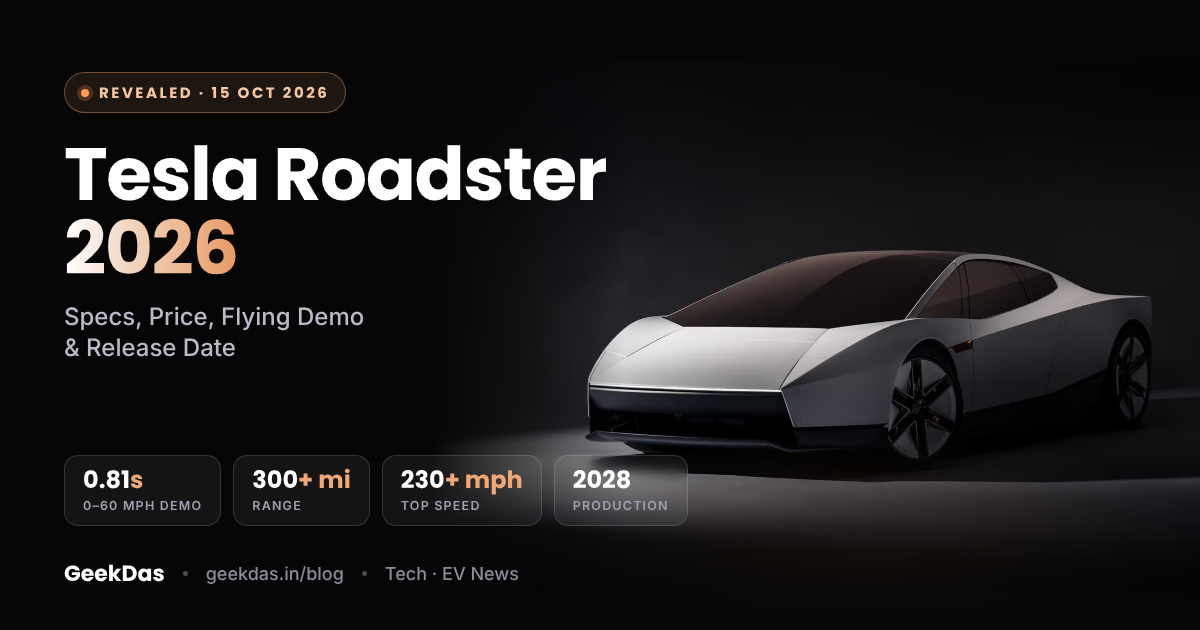
After nearly ten years of delays, Tesla finally showed its next-generation Roadster on Thursday, 15 October 2026. The event was held at a SpaceX test site near Waco, Texas, two weeks after the original 1 October date, which Tesla postponed due to bad weather.
The car drove up a curved ramp until it was upside down, launched off, flipped in mid-air and used SpaceX-developed thrusters to land upright.
Searches for "Tesla Roadster" and "tesla flying car" are trending worldwide. This guide explains what was announced, how the "flying" works, what it costs, and when and where you might actually be able to buy one.
Tesla Roadster 2026 at a Glance
Detail | What Tesla announced |
|---|---|
Reveal date | 15 October 2026 (postponed from 1 October) |
Versions | Performance, Thrust, Rocket |
0–60 mph (claimed) | Under 1.6 s (Performance) to under 0.59 s (Rocket) |
0–60 mph (demo run) | 0.81 seconds |
Range | 300+ miles (about 480 km) |
Top speed | Above 230 mph (about 370 km/h) |
Price | Not announced |
Reservation | $50,000 (Performance), $250,000 (Thrust), Rocket is invite-only |
Production start | 2028 |
Important: These are Tesla's own claims. No independent testing has been done yet, and specs often change before production.
What Tesla Showed at the Reveal
The Inverted Ramp Demo
The Roadster drove partway up a half-pipe style ramp. A vacuum fan system pressed it against the surface until it was completely upside down. It then pushed off, flipped and used thrusters to correct its position before landing on the pavement below.
The Car-Jump Demo
The second demo had the Roadster jumping over a Cybercab, Cybertruck, Tesla Semi, Model Y and Model 3, then landing using its thrusters. Musk's reaction after the landing was simply: "Well, it worked."
What Musk Said
Musk called it "the best of the last of the human-driven cars" but admitted it may not "move the needle massively from a revenue standpoint." It's a showcase, not a volume product.
Watch the Reveal
This 10-minute highlight video from CNET shows both demos and the key announcements.
Video: CNET on YouTube. Prefer a longer cut? Watch Space.com's 16-minute version of the unveiling.
The Three Roadster Versions Explained
Tesla's reservation page lists three versions, each more extreme than the last.
Performance ("Road Ready")
Seats: 2
Key tech: Active aerodynamics and a multi-mode suction (fan) system
0–60 mph: under 1.6 seconds (claimed)
Reservation: $50,000
This is the version most buyers would actually drive on public roads.
Thrust ("Race Ready")
Seats: 2
Key tech: Rear-mounted cold-gas thrusters for acceleration
0–60 mph: under 0.9 seconds (claimed)
Reservation: $250,000
Rocket ("Air Ready")
Seats: 1
Key tech: Cold-gas thrusters placed around the whole car, allowing short hops and mid-air rotation
0–60 mph: under 0.59 seconds (claimed)
Availability: Invite-only
It's still unclear how the Rocket version could be legally driven on public roads.
How the "Flying" Actually Works
The Roadster isn't an aircraft. It uses three systems working together.
Suction Fans
Powerful fans pull air from under the car, pushing it down onto the road or ramp. This greatly increases grip and is what let the car stay attached to an inverted ramp.
Cold-Gas Thrusters
According to Tesla engineering VP Lars Moravy, 10 thrusters connected to about 600 litres of compressed air can lift and spin the car. These are "cold gas" thrusters. They release pressurised air, not burning fuel, and the air tank can be recharged.
Why Thrusters Beat Tires
Tesla says every car is limited by "tire grip." Its argument is that the thrusters produce 4–5 times more force than the tires can, which is how it claims sub-1-second acceleration.
The COPV Concern
Tesla says it filled "every usable void" in the car with Carbon Fiber Overwrapped Pressure Vessels (COPVs) to store the air. TechCrunch noted this vessel type has been linked to past SpaceX rocket failures, which raises fair questions about crash safety.
Roadster 2017 Promise vs 2026 Reveal
First shown in 2017, the Roadster was promised for 2020. Here is how the claims have changed.
Spec | 2017 announcement | 2026 reveal |
|---|---|---|
0–60 mph | 1.9 s | Under 1 s (Thrust and Rocket) |
Range | 620 miles (1,000 km) | 300+ miles (about 480 km) |
Top speed | Above 250 mph | Above 230 mph |
Seats | 2+2 | 2 (or 1 for Rocket) |
Battery | 200 kWh (claimed) | Not disclosed |
Base price | $200,000 | Not announced |
Deliveries | 2020 | Production from 2028 |
The biggest change is range, which has roughly halved from the original promise. Acceleration is the headline improvement, thanks to the thrusters.
Price and Reservation: How It Works
No Official Price Yet
Tesla did not announce a price. In 2017, it quoted a $200,000 base price, and reports now expect the final price to be above $250,000.
How the $50,000 Reservation Works
For the Performance version, buyers pay a $5,000 deposit, then a $45,000 wire transfer within 10 days. That's $50,000 committed upfront for a car that won't enter production until 2028.
Practical Examples: What These Numbers Mean
Example 1: The 0.81-Second Demo
Reaching 60 mph (about 97 km/h) in 0.81 seconds means accelerating at about 3.4g, more than three times the force of gravity. For comparison, a typical family car takes around 8–10 seconds to reach 60 mph, and even most supercars need 2.5 seconds or more.
Example 2: What 300 Miles of Range Covers
300 miles (about 480 km) covers a one-way drive like Los Angeles to Las Vegas (about 270 miles), but not Los Angeles to San Francisco (about 380 miles) without charging. Hard driving will cut range further.
Example 3: The Cost of Reserving
A $50,000 reservation is more than the full price of a new Tesla Model 3 in the US. You'd be paying that as a deposit for a car that enters production in 2028 at the earliest, with the final price still unknown.
Release Date and Global Availability
Production Timeline
Musk said, "We enter production in 2028." Given the Roadster's history of missed dates, first deliveries could slip later than that.
Who Gets It First
Tesla hasn't published a country-by-country plan. Based on past rollouts, the US will likely come first, followed by markets where Tesla already sells and services cars, such as Europe, the UK, China, Canada and Australia. Check Tesla's website for your region.
Import Costs Outside the US
Outside the US, the final cost will depend on local import duties, luxury taxes and registration rules, which can add a lot to the US price. Where Tesla has no official sales, private import may be the only option.
Road-Legality Questions
Each country sets its own safety and homologation rules. The thruster-equipped Thrust and Rocket versions may face extra restrictions, and their road legality is unclear even in the US.
Why the Roadster Matters
Technology Spillover
Ideas like fan-based downforce and thruster control could influence future EV and racing tech.
A Shift in EV Perception
Like the original 2008 Roadster, which proved EVs could be exciting, this car is mainly about image and engineering ambition.
The Skeptics' View
Not everyone is convinced. Investor Gene Munster called it "an engineering flex with no commercial value." YouTuber Marques Brownlee questioned the claims given the car's 4,000+ pound weight. Musk himself said "safety is not the main goal" and that safety-focused buyers shouldn't buy it.
Tesla Roadster vs Other Fast EVs
Car | 0–60 mph (manufacturer claim) | Top speed | Status |
|---|---|---|---|
Tesla Roadster (Thrust) | Under 0.9 s | 230+ mph | Production from 2028 |
Rimac Nevera | About 1.74 s | About 258 mph | On sale |
Lucid Air Sapphire | Under 2 s | 205 mph | On sale |
Original Tesla Roadster (2008) | About 3.7–3.9 s | 125 mph | Discontinued (2012) |
If Tesla delivers on its claims, the Roadster would be far quicker than any production car today. That's still a big "if."
Conclusion
The 2026 Tesla Roadster is the most outrageous car reveal in years: suction fans, SpaceX cold-gas thrusters, a claimed sub-1-second 0–60 time and short flying hops. Here is what's confirmed so far:
Revealed: 15 October 2026, near Waco, Texas
Versions: Performance, Thrust and Rocket
Range: 300+ miles
Price: not announced; reservations from $50,000
Production: 2028
Availability: US first is likely; no country-by-country plan announced
Treat the specs as promises until independent tests arrive. For more explainers on tech, EVs and trending topics, visit the GeekDas blog.
Was this article helpful?